
Quick Answer: IPTV and OTT both deliver video using Internet Protocol, but they describe different delivery models. Traditional IPTV usually delivers live television and on-demand video through a private, managed network controlled by a telecom company, internet service provider, or organization. Over-the-top (OTT) streaming delivers video through the public internet, normally using cloud infrastructure, a content delivery network (CDN), and apps or web players.
Neither option is universally better. OTT is usually the more flexible choice for a new streaming platform, a broadcaster, a creator, or a business that wants to reach viewers across countries and devices. IPTV can be the stronger choice when an operator already owns a managed network and needs predictable service quality, channel-based television, or tightly controlled distribution. In many modern deployments, the practical answer is a hybrid IPTV and OTT platform.
The most important distinction is not the acronym. It is who controls the network, where the viewer can watch, how the service scales, and what experience the audience needs.
IPTV vs OTT vs IPTV App: Why People Confuse These Terms
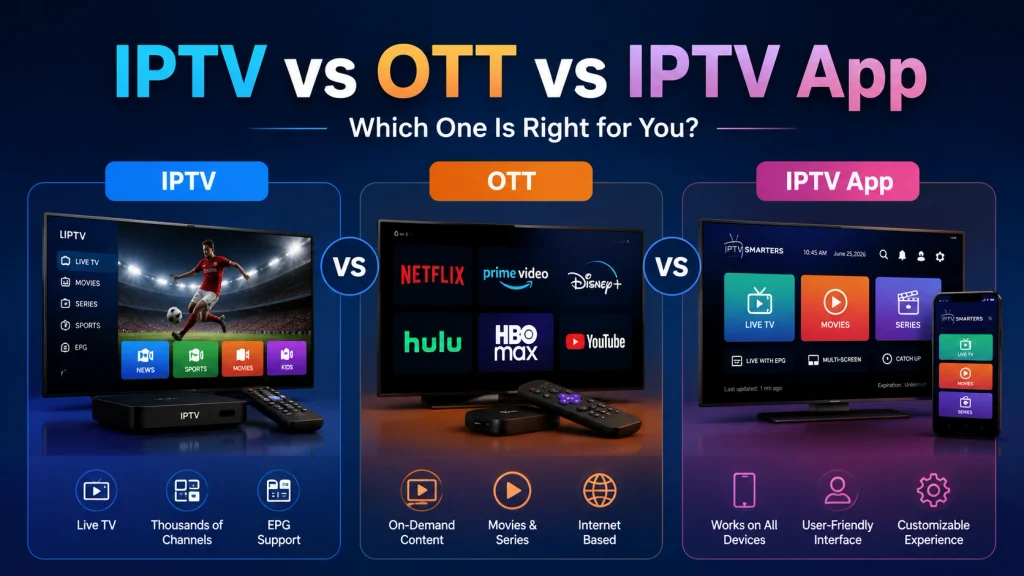
A major source of confusion is that people often use “IPTV” to mean three different things: the delivery technology, a television service, and the application used for playback. These are not interchangeable.
IPTV is a method of delivering television or video over an IP-based network. An IPTV service is the provider’s product, which may include live channels, video on demand (VOD), catch-up TV, an electronic program guide (EPG), and account access. An IPTV player is the app or software that loads and plays a provider’s playlist or login; the player normally does not supply the channels itself. See this guide to what IPTV is and how it works for a fuller introduction.
Similarly, OTT describes a distribution model, not one specific company. Netflix, YouTube, Disney+, broadcaster apps, sports platforms, ad-supported channels, and many private video services can all use OTT streaming. The brand, catalog, subscription plan, and app are separate from the underlying delivery architecture.
What Is IPTV?
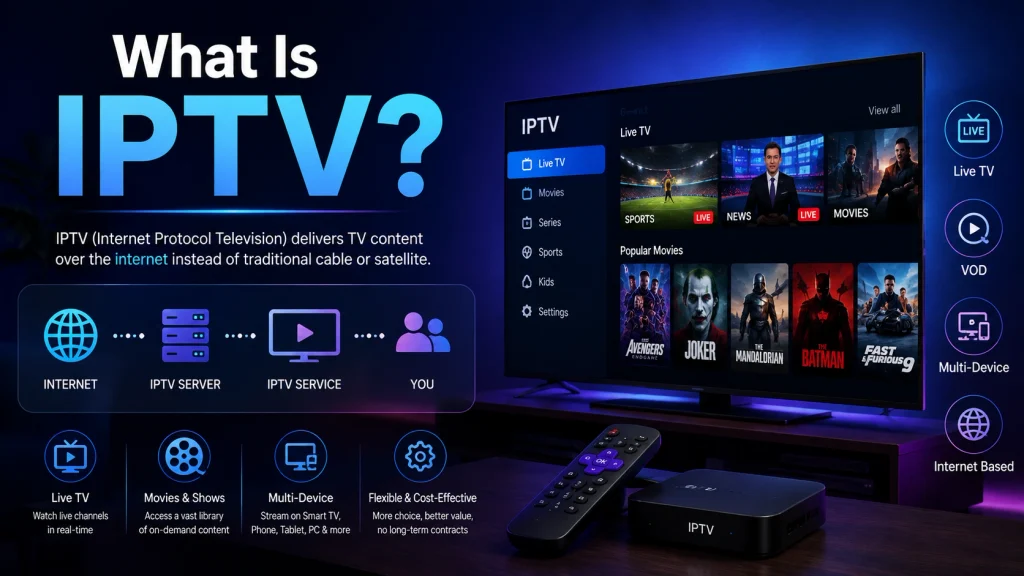
IPTV means Internet Protocol Television. It is a system for transmitting television programming as IP data rather than using a traditional terrestrial broadcast, satellite signal, or conventional cable distribution path.
In the classic IPTV model, the provider controls much of the path between its video headend and the customer. That may include the access network, middleware, authentication, set-top box, electronic program guide, and quality-of-service policies. Telecom and ISP television bundles are common examples, but managed IPTV can also be used in hotels, hospitals, campuses, offices, and other private environments.
An IPTV service may contain several viewing modes:
| IPTV viewing mode | How it works | Typical example |
|---|---|---|
| Live IPTV | A scheduled channel is delivered in real time. | News, sports, or a linear entertainment channel |
| IPTV VOD | The viewer selects stored content from a library. | A movie or episode started on demand |
| Catch-up TV | Recently broadcast programs remain available for replay. | Watching yesterday’s news later |
| Time-shifted TV | The viewer pauses, rewinds, or restarts supported programming. | Restarting a live program from the beginning |
| Near video on demand | The same program starts at scheduled intervals. | A movie beginning every 15 or 30 minutes |
A provider may use multicast for many viewers watching the same live channel and unicast for individual VOD requests. The exact architecture varies by operator, region, device, and service design. Therefore, not every product marketed as “IPTV” uses the same network model.
What Is OTT (Over-the-Top)?
Over-the-top (OTT) is the delivery of video over the public internet without requiring the viewer to use a traditional cable, satellite, or telecom television network. The term means that the service operates “over the top” of an existing internet connection instead of being tied to the network operator’s television infrastructure. Telestream’s OTT overview describes OTT as internet delivery of television and film content according to the viewer’s request.
An OTT platform generally combines cloud video hosting, encoding, packaging, authentication, a CDN, one or more playback apps, analytics, and a monetization system. Viewers may watch in a browser or on a smart TV, phone, tablet, game console, Roku, Apple TV, Android TV, or Fire TV device, depending on the service.
OTT services can use several business models:
| OTT model | Meaning | Common use |
|---|---|---|
| SVOD | Subscription video on demand | Monthly or annual streaming library |
| AVOD | Advertising-supported video on demand | Free or lower-cost viewing with ads |
| TVOD | Transactional video on demand | Rental or purchase of an individual title |
| FAST | Free ad-supported streaming television | Linear-style channels supported by advertising |
| Hybrid | Two or more models together | Subscription plus rentals or advertising |
OTT is not limited to on-demand movies. It can deliver live sports, news, concerts, education, enterprise broadcasts, religious programming, and interactive events. A live OTT service still uses the public internet; the difference is that it transmits content in real time rather than selecting it from a finished catalog.
How Does IPTV Streaming Work?
A simplified IPTV streaming workflow begins when a provider acquires lawful rights to distribute channels or programs. The source feed is then encoded and compressed into formats supported by the target devices. The service may add program metadata, channel logos, EPG information, authentication, digital rights management (DRM), and entitlement rules.
The stream is sent through the operator’s managed IP infrastructure or a controlled distribution network. For live linear television, multicast can deliver one channel stream efficiently to many subscribers. For VOD, the system typically responds to an individual viewer request. A set-top box or compatible application receives the stream, buffers a small amount of data, decodes it, and presents the program on the screen.
IPTV’s main technical advantage is network control. The operator may be able to prioritize video traffic, monitor the access path, manage devices, and troubleshoot a known service environment. That control can make IPTV well suited to fixed locations and traditional television bundles.
However, “managed network” does not mean every IPTV stream is automatically perfect. Wi-Fi interference, a weak home network, overloaded provider equipment, poor encoding, insufficient capacity, or an unreliable application can still cause interruptions.
How Does OTT Streaming Work?
OTT streaming normally follows a multi-stage internet video pipeline:
- The provider ingests a live feed or uploads a recorded file.
- The source is encoded into one or more resolutions and bitrates.
- The video is segmented and packaged, commonly for HLS or MPEG-DASH.
- A CDN distributes the segments from edge locations closer to viewers.
- The viewer’s app or browser requests a manifest and then downloads media segments.
- The player adjusts quality when network conditions change.
Apple’s HTTP Live Streaming documentation explains how HLS can deliver live and on-demand media over ordinary HTTP infrastructure. MPEG’s DASH resources cover the international standard for dynamic adaptive streaming over HTTP.
The quality-adjustment step is called adaptive bitrate streaming (ABR). A service prepares multiple versions of the same program, and the player chooses among them based on available bandwidth, device capability, buffer health, and other measurements. The viewer may see the quality move from 4K to HD or a lower resolution during congestion, but playback can continue instead of stopping completely.
A CDN is also important. It places copies or delivery points closer to users so that every viewer does not have to connect directly to one origin server. The site’s explanation of CDN in IPTV discusses edge delivery, caching, live-stream behavior, and why peak-event performance can reveal capacity problems.
IPTV vs OTT: Side-by-Side Comparison Table
| Comparison point | IPTV | OTT |
|---|---|---|
| Network | Usually private or operator-managed IP network | Public internet |
| Network control | High control by the telecom, ISP, or organization | The provider controls the application and delivery service but not the viewer’s last-mile network |
| Typical experience | Channel-oriented television with EPG and set-top box support | App- or web-oriented viewing across many device types |
| Live delivery | Often multicast in managed environments; unicast may also be used | Commonly unicast through a CDN |
| Device reach | Often limited to supported boxes, TVs, or operator apps | Usually broad: web, mobile, smart TV, consoles, and streaming sticks |
| Geographic reach | Commonly tied to network footprint or service territory | Potentially global, subject to rights and regional restrictions |
| Video on demand | May be included alongside live channels | Central to many services, although OTT can also be live |
| Quality behavior | More predictable when the network is well managed | Adaptive quality responds to public-internet conditions |
| Latency | Often lower and more predictable for managed live delivery | Varies by protocol, player, CDN, and latency target |
| Monetization | Frequently bundled with broadband or pay TV | SVOD, AVOD, TVOD, FAST, advertising, pay-per-view, or hybrid |
| Deployment | More dependent on network and hardware infrastructure | Usually faster to launch using cloud and CDN services |
| Best fit | Telco TV, hospitality, healthcare, campuses, and fixed subscriber bases | Global streaming services, events, brands, educators, creators, and multi-device audiences |
These are traditional tendencies, not absolute rules. Some IPTV products use public internet delivery, and many OTT providers offer excellent quality. Always examine the actual service architecture instead of relying on its label.
8 Key Differences Between IPTV and OTT Streaming
1. Managed Network vs. Open Internet
The fundamental difference between IPTV and OTT is the network underneath the video. A traditional IPTV operator manages the distribution environment and may control access, routing, and supported hardware. OTT works across networks that the video provider generally does not own, including home broadband, mobile data, public Wi-Fi, and third-party internet connections.
This explains why IPTV can offer more predictable performance in a controlled environment, while OTT needs ABR, CDN engineering, monitoring, and resilient application design to handle variation.
2. Device Flexibility and Reach
IPTV may be closely associated with an operator-supplied set-top box, although modern services can also support smart TVs, phones, and web apps. OTT is designed from the start for heterogeneous devices. A single OTT platform may serve a browser, iOS and Android applications, connected TVs, consoles, and streaming sticks.
For viewers who regularly move between devices, OTT usually provides the simpler experience. For a hotel room, hospital ward, or managed campus where devices and network access are known, IPTV’s narrower device model may be an advantage.
3. Live Channels vs. On-Demand Libraries
IPTV commonly recreates a traditional television experience: channel numbers, a schedule, EPG data, live events, and optional VOD. Many OTT platforms are organized around a catalog, search, recommendations, and profiles, although live OTT channels have become common.
The distinction is not “IPTV equals live” and “OTT equals VOD.” Both can provide both types of content. VOD means that the viewer selects stored content and starts it when convenient; it is a viewing model that can exist inside IPTV or OTT.
4. Reliability, Buffering, and Quality of Service
Managed IPTV can have a QoS advantage because the operator controls a larger part of the delivery path. OTT cannot guarantee the condition of every home Wi-Fi network, mobile connection, transit provider, or last-mile ISP. It compensates through adaptive bitrate ladders, CDN selection, buffering strategy, player telemetry, and capacity planning.
This does not make OTT inherently low quality. In practice, a well-engineered OTT service can deliver stable HD or 4K playback to a large audience. Conversely, a poorly operated IPTV service can buffer. The relevant questions are: Is the connection stable? Is the provider’s origin and CDN capacity sufficient? Is the app reliable? Is the stream encoded correctly?
5. Latency for Live Events
Latency is the delay between the real-world event and the picture on the viewer’s screen. Traditional managed IPTV can achieve low, predictable latency, particularly when its network and distribution method are designed for live television. Standard HTTP-based OTT delivery may introduce more delay because video is encoded, segmented, distributed, buffered, and played through an internet stack.
Low-latency HLS, low-latency DASH, WebRTC, shorter segments, tuned player buffers, and edge delivery can reduce the gap. The correct choice depends on the event. A casual entertainment channel may not need sub-second latency; live betting, auctions, interactive classes, and competitive sports may have stricter requirements.
6. Cost and Scalability
IPTV can require managed network capacity, headend systems, conditional access, middleware, set-top boxes, installation, and operational support. Those investments can be justified when the operator already owns a broadband network or serves a known location.
OTT avoids the need to build a private television access network, but it is not free. Costs may include encoding, storage, CDN egress, DRM, app development, monitoring, customer support, content rights, and payment processing. Cloud delivery can scale with the audience, but a major live event can produce a substantial usage bill.
7. Monetization and Customer Relationship
IPTV is often sold as part of a broader telecom or pay-TV bundle. The provider may own the billing relationship, subscriber authentication, set-top box, and service bundle.
OTT gives a media business more direct control over its brand, apps, sign-up journey, audience data, pricing experiments, advertising, and distribution. It can support subscriptions, ads, rentals, purchases, free trials, or a combination. App-store fees, payment rules, regional taxes, and content licensing still need to be considered.
8. Security, Rights, and Geographic Availability
Both models require access control and content protection. A legitimate provider must have the rights needed to distribute its channels, movies, series, and sports in the relevant country or territory. DRM, secure tokens, account entitlements, encryption, watermarking, and monitoring may be used depending on the content and risk profile.
A VPN may change the apparent network location, but it does not create content rights and may violate a service’s terms. For a practical privacy and network-security discussion, see the site’s VPN for IPTV guide. The safest approach is to choose a provider that clearly explains its service, terms, privacy practices, supported regions, and licensing position.
IPTV vs OTT: Which Is Better for Viewers in 2026?
For most viewers choosing between a traditional IPTV service and an OTT platform, the answer depends on viewing habits.
OTT may be better if you want a service that works on multiple devices, a flexible on-demand catalog, global or cross-region access where licensed, fast sign-up, separate apps, and the ability to combine different specialist services. OTT is particularly convenient for viewers who use a smart TV, phone, tablet, laptop, console, or streaming stick interchangeably.
IPTV may be better if you want a conventional live-TV experience, a channel guide, a fixed package, a provider-managed set-top box, or a service bundled with your broadband. It can also be a good fit when the service is designed for a known network and household environment.
Before subscribing, compare the actual catalog, supported devices, simultaneous-stream rules, catch-up and VOD features, video quality, customer support, cancellation terms, privacy policy, and the provider’s right to distribute content. A large channel count alone does not prove reliability or legality. If you use an IPTV player, start with the site’s IPTV player comparison and confirm that the app supports your provider’s login or playlist format.
IPTV vs OTT for Businesses: Which Should You Choose?
A new streaming business normally starts by defining its audience, rights, geography, latency requirement, device list, and monetization plan. The technology should follow those requirements.
| Business requirement | Usually the better starting point | Reason |
|---|---|---|
| Global or multi-region audience | OTT | No private television access network is required for each territory |
| Existing ISP broadband network | IPTV or hybrid | The operator can use network assets and bundle television with connectivity |
| Hotel or hospital rooms | Managed IPTV or hybrid | Fixed locations and controlled devices simplify distribution |
| Direct-to-consumer subscription | OTT | Apps, payments, analytics, and catalog discovery are central |
| High-volume live sports | OTT, IPTV, or hybrid after latency testing | The right model depends on latency, rights, audience geography, and capacity |
| Internal campus or enterprise video | Managed IPTV or private OTT | Access control and known networks may matter more than global reach |
| Fast market validation | OTT | Cloud infrastructure can reduce hardware and network deployment time |
| Home television plus mobile viewing | Hybrid | IPTV can serve the home while OTT extends access outside it |
For an operator, the decision is often not “IPTV versus OTT” but “which viewers should receive which delivery path?” A hybrid platform may use IPTV for a managed home connection and OTT for mobile, web, smart-TV, or out-of-home viewing. Industry technology providers increasingly describe this convergence as a way to combine controlled television delivery with broader device reach.
Is Netflix IPTV or OTT? Is YouTube IPTV or OTT?
Netflix is generally classified as an OTT platform because it delivers video over the public internet through apps and web-connected devices. YouTube is also generally considered OTT for the same reason. A live channel inside an OTT app remains OTT if the service reaches the viewer through the public internet.
An IPTV service can also have an app, and an OTT platform can offer live channels. Therefore, the app’s appearance or the presence of live content is not enough to classify the service. Look at the underlying delivery model: Is the service tied to a provider-managed network, or can it operate over an ordinary internet connection?
What Is a Hybrid IPTV-OTT Platform?
A hybrid platform combines managed IPTV delivery with OTT delivery under one service operation. The provider may share a content catalog, subscriber database, entitlement system, billing platform, analytics layer, and customer account while choosing different distribution paths for different devices.
For example, a broadband operator could deliver low-latency live channels to a home set-top box over its managed network, then provide an OTT app for a subscriber watching on a phone while travelling. The hybrid approach can improve reach without abandoning the television experience that existing customers understand.
Hybrid does add complexity. The operator must manage device certification, app updates, network differences, entitlement synchronization, content rights, DRM, support workflows, and consistent user experience. It is valuable when the audience genuinely needs both models, not simply because “hybrid” sounds modern.
Is IPTV Legal? IPTV vs OTT Legality Explained
IPTV and OTT are technologies and delivery models. Neither is automatically legal or illegal. Legality depends mainly on the provider’s rights to distribute the specific channels and content, the terms of service, and the laws applicable to the viewer’s country.
A legitimate service should provide understandable information about its company, pricing, privacy policy, refund terms, supported devices, and content offering. Be cautious about services that promise every premium channel and sporting event at an implausibly low price, ask users to install unknown software, hide their business identity, or provide no clear explanation of rights.
The same standard applies to OTT platforms: an app being available on a device does not by itself prove that every piece of content is licensed in every location. Check the service’s official terms and regional availability.
IPTV or OTT Buffering? How to Troubleshoot Streaming Issues
A useful diagnosis separates the viewer’s home network from the provider’s delivery system. First test whether other services work normally on the same device and connection. Then check whether the issue affects every channel or only one stream, whether it occurs only during a major live event, and whether Ethernet performs better than Wi-Fi.
If every service buffers, investigate the broadband connection, router, Wi-Fi interference, device load, and local network. If only one service or channel fails while other video works, the problem may involve that provider’s origin server, CDN, encoding, or capacity. If VOD is stable but live channels fail at peak times, live distribution capacity and latency settings deserve attention.
For IPTV setup questions, see how to use IPTV and the Fire TV Stick player guide. For a traditional-TV comparison, see IPTV vs cable TV.
Final Verdict: IPTV vs OTT – Which Is Better?
Choose OTT when your priority is device freedom, direct-to-consumer distribution, quick deployment, on-demand discovery, global reach, or flexible monetization. Choose IPTV when you control a managed network, serve a defined location or subscriber base, need a traditional channel experience, or want network-level control. Choose hybrid delivery when your audience needs reliable home television and convenient mobile, web, or out-of-home access.
The best decision is made by evaluating the audience rather than repeating a technology label. Ask five questions: Where are viewers located? Which devices do they use? Is the content live, on demand, or both? How much latency is acceptable? Does the provider have the rights, capacity, security, and support needed for the service?
There is no universal winner. OTT usually wins on reach and flexibility; IPTV usually wins on managed control; hybrid platforms can combine both when the business case justifies the added complexity.
FAQs: IPTV vs OTT
-
What is the main difference between IPTV and OTT?
Traditional IPTV uses a private or operator-managed IP network, while OTT uses the public internet. IPTV generally offers more control over the network and supported devices; OTT generally offers broader reach and more flexibility.
-
Is OTT better than IPTV?
Not in every situation. OTT is usually better for multi-device and direct-to-consumer services. IPTV can be better for telecom bundles, hotels, campuses, hospitals, and other controlled environments. A hybrid approach may be best for operators that need both.
-
Is IPTV streaming the same as OTT streaming?
Both are forms of internet-protocol video delivery, but they are not identical. IPTV streaming traditionally refers to delivery over a managed network, whereas OTT streaming generally travels across the public internet. In modern products, the terms can overlap, so examine the actual architecture.
-
Does OTT mean only Netflix-style on-demand video?
No. OTT includes on-demand libraries as well as live sports, news, events, education, enterprise broadcasts, FAST channels, and other internet-delivered video services.
-
Can IPTV include VOD?
Yes. Many IPTV services combine live channels with movies, series, catch-up programming, and VOD. VOD describes how viewers choose stored content, not whether the delivery system is IPTV or OTT.
-
Which has lower latency, IPTV or OTT?
Managed IPTV can have lower and more predictable live latency, but modern OTT can reduce delay with low-latency protocols and carefully designed delivery. The actual result depends on the provider, protocol, player buffer, CDN, and network conditions.
-
Do I need an IPTV box to use IPTV?
Not always. Some services support smart-TV apps, phones, computers, streaming sticks, or web players. The answer depends on the provider and its supported applications. Check compatibility before subscribing.
-
Is IPTV legal?
IPTV technology is legal. A specific IPTV service is lawful only when it has the appropriate rights and follows applicable laws and terms. Choose providers that are transparent about their business, policies, content, and supported regions.
-
Does a VPN make an IPTV service legal?
No. A VPN can affect privacy or how a connection is routed, but it does not grant a provider the rights to distribute copyrighted content and may conflict with a service’s terms. Consider the provider’s licensing and your local law separately.