Your ticket says 7 p.m. The scoreboard promises 60 minutes of hockey. So when do you actually get home? Here is how long NHL games really last, game by game instead of guessed.
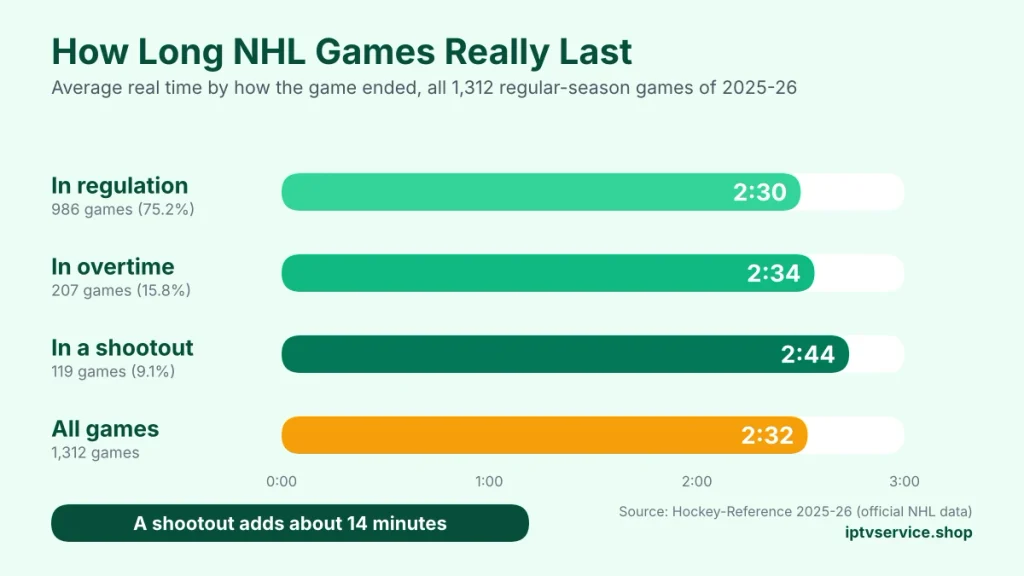
An NHL game takes about 2 hours 30 minutes from puck drop to final horn. Across all 1,312 regular-season games of 2025-26 the average was 2 hours 32 minutes: 2:30 when a game ended in regulation, 2:34 when overtime decided it and 2:44 when it went to a shootout.
Below you will find where those minutes go, the official 18-minute intermission rule, how overtime works and what time a 7 p.m. game really ends. If you want the bigger picture first, our guide to how many NHL games there are in a season explains the new 84-game schedule.
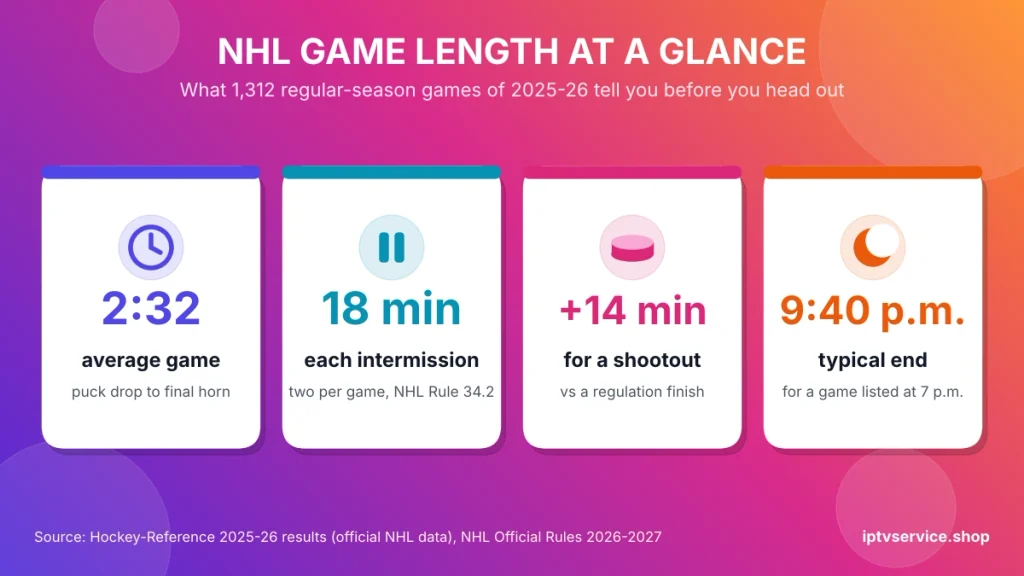
The four numbers that shape an NHL night, based on all 1,312 regular-season games of 2025-26
Key Takeaways
NHL games have 60 minutes of play but take about 2.5 hours of real time. All 1,312 regular-season games of 2025-26 averaged 2:32.
Intermissions are 18 minutes each under Rule 34.2 of the NHL Official Rules 2026-2027, not the 15 or 17 minutes many sites quote.
A game decided in overtime ran about 5 minutes longer than a regulation game. A shootout added about 14 minutes.
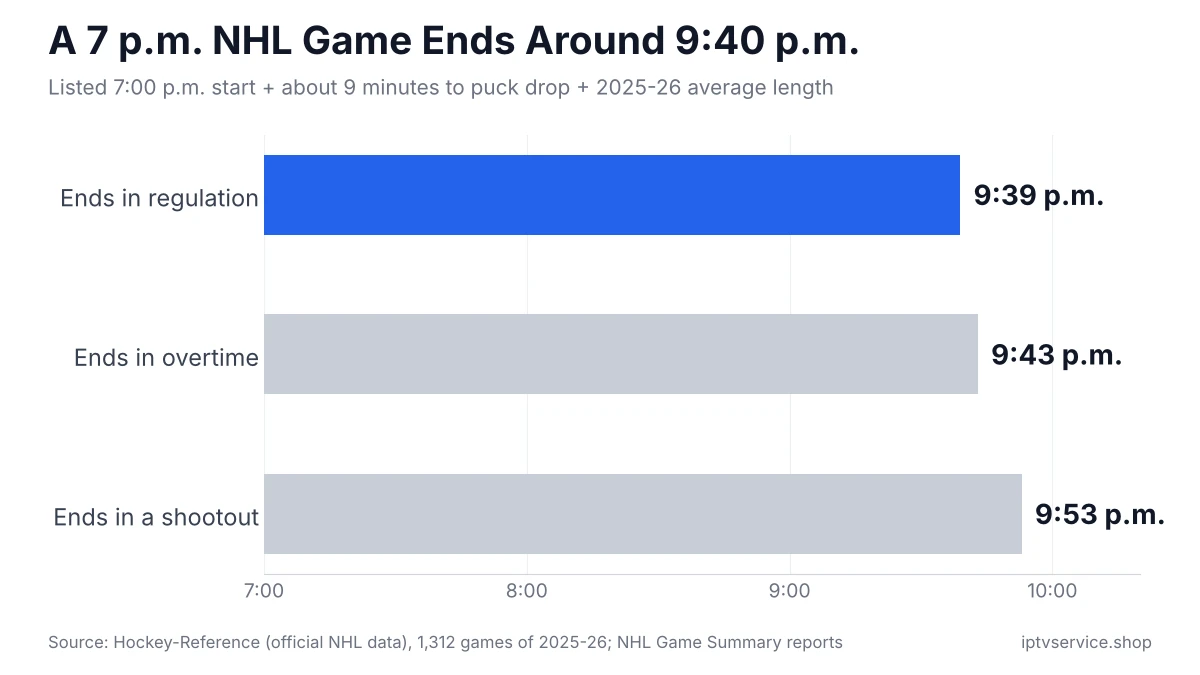
A game listed for 7:00 p.m. usually ends around 9:40 p.m. local time. After a shootout it ends closer to 9:55 p.m.
How Long Are NHL Games? The Short Answer
NHL games last about two and a half hours in real time, even though only 60 minutes are played. Hockey runs on two clocks. The game clock counts three periods of 20 minutes. The wall clock counts everything else too.
The game clock stops at every whistle. On top of that come two long breaks between periods, TV timeouts and video reviews. Add it all up and a regular-season NHL game lands at about 150 minutes.
Think of it as a one-hour meeting with two coffee breaks and a lot of “quick questions.” The agenda says one hour. Nobody gets out in one hour.
How Long NHL Games Really Last: All 1,312 Games of 2025-26
Across the whole 2025-26 regular season the typical NHL game lasted 2:32 and three out of four games finished within 2:20 to 2:40. Here is how the numbers break down by how each game ended.
How the game ended
Games
Share
Average length
Shortest
Longest
In regulation (60 minutes)
986
75.2%
2:30
2:09
3:04
In overtime
207
15.8%
2:34
2:18
2:51
In a shootout
119
9.1%
2:44
2:29
3:16
All regular-season games
1,312
100%
2:32
2:09
3:16
Source: Hockey-Reference 2025-26 results (official NHL data), 10 games checked against NHL Game Summary reports; calculations by iptvservice.shop, verified October 2026
Shootout games ran about 14 minutes longer than regulation games in 2025-26
How We Collected This Data
We took the “length of game” for all 1,312 regular-season games and all 82 playoff games of 2025-26 from Hockey-Reference’s 2025-26 results page, which uses official NHL data. We then opened 10 of the NHL’s own Game Summary reports, which print the exact start and end time of each game, like this one from December 1, 2025. Eight matched to the minute. Two did not, so we used the official times: that December 1 game was listed at 1:38 but really ran 2:31 and the outdoor game in Tampa was listed at 3:18 but ran 3:16. Length means puck drop to final horn. It does not include the pregame show.
Regulation vs Overtime vs Shootout
Three out of four games ended in regulation. Those took 2 hours 30 minutes on average, which is exactly where the familiar “two and a half hours” comes from.
The other 326 games went past 60 minutes. Overtime settled 207 of them (63.5%) and the remaining 119 needed a shootout. In other words, almost two out of three overtimes end with a goal before anyone has to shoot.
Overtime itself barely moves the clock. A game decided in overtime ran only about 5 minutes longer than a regulation game. A shootout game ran about 14 minutes longer because the ice is shoveled again and the shooters go one at a time.
Most Games Fall Inside a 20-Minute Window
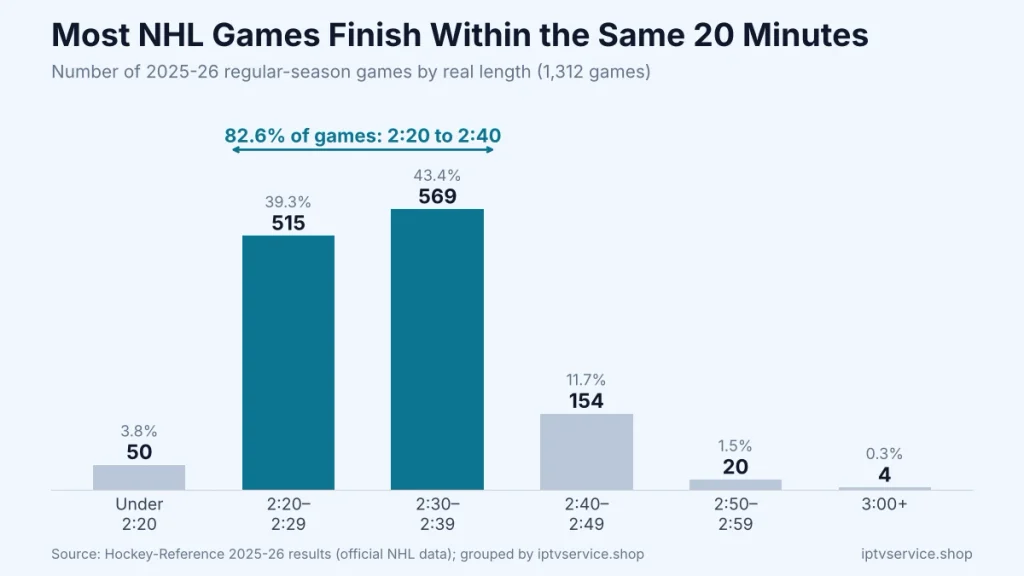
Most NHL games finish within a few minutes of each other. Here is how all 1,312 games were spread out.
Real game length
Games
Share
Under 2:20
50
3.8%
2:20 to 2:29
515
39.3%
2:30 to 2:39
569
43.4%
2:40 to 2:49
154
11.7%
2:50 to 2:59
20
1.5%
3:00 or longer
4
0.3%
Source: Hockey-Reference 2025-26 results (official NHL data), 1,312 regular-season games; grouped by iptvservice.shop, verified October 2026
82.6% of 2025-26 regular-season games finished between 2:20 and 2:40
That means 82.6% of games finished between 2:20 and 2:40. Only 24 of 1,312 games (1.8%) reached 2:50 and just four crossed three hours.
The Fastest and Slowest Games of the Season
The quickest games took 2:09 and the slowest took 3:16. Two games tied for fastest: Florida’s 4-0 win at Edmonton on March 19, 2026 and Winnipeg’s 2-1 win at Columbus on April 4, 2026.
The longest was the outdoor game at Raymond James Stadium in Tampa on February 1, 2026. Tampa Bay beat Boston 6-5 in a shootout in front of 64,617 fans and the game ran 3:16. The longest indoor game was Nashville’s 5-4 shootout win in Los Angeles on April 2, 2026 at 3:09. The same night Calgary at Vegas took 3:04 without any overtime at all, the longest regulation game of the season.
The gap between the fastest and slowest games is more than an hour. For a fan planning a late drive home, that is the difference between beating traffic and sitting in it.
Does the Home Team Make a Difference?
Only a little. When we grouped games by home team, the gap between the quickest and slowest buildings was under eight minutes.
Home team
Home games
Average length
Went past regulation
Winnipeg Jets
41
2:28
8
New Jersey Devils
41
2:28
12
Vancouver Canucks
41
2:29
8
League average
1,312
2:32
326
Tampa Bay Lightning
40
2:34
7
Los Angeles Kings
41
2:34
14
Vegas Golden Knights
41
2:36
11
Source: Hockey-Reference 2025-26 results (official NHL data); averages by iptvservice.shop, verified October 2026. Outdoor and neutral-site games (Stockholm, Sunrise and Tampa stadium games) are left out of the team rows
Extra time explains part of it. Los Angeles hosted 14 games that went past regulation and six of them reached a shootout. Either way, no building changes your night by more than a few minutes.
What the First Week of 2026-27 Shows
The new 84-game season started on September 29, 2026. The 34 games played through October 3 averaged 2:34. The 26 regulation games averaged 2:33 and the eight overtime games averaged 2:39. There were no shootouts yet.
That is two minutes longer than last season’s average. It is far too early to call it a trend. October was also the slowest month of 2025-26 at 2:33 before games settled at 2:31 to 2:32. (Source: Hockey-Reference 2026-27 results, checked October 7, 2026.)
Where the 2.5 Hours Go
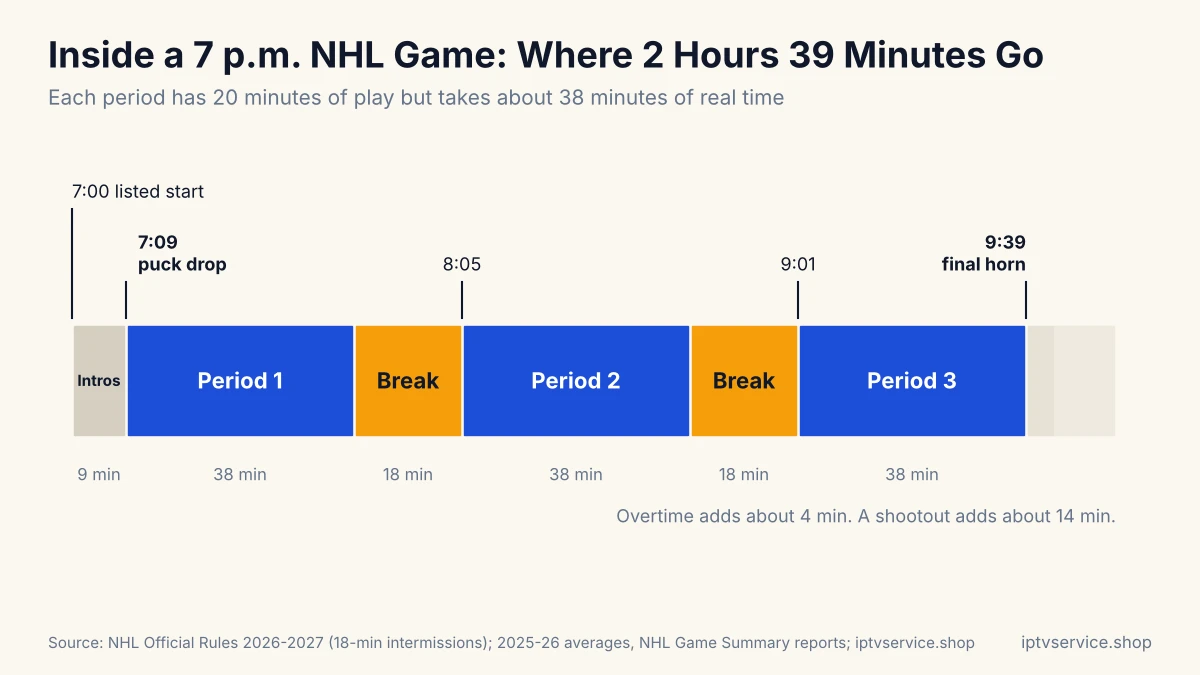
About 60 minutes of a regulation game is hockey, 36 minutes is intermission and the remaining 54 minutes is stoppages. The NHL Official Rules 2026-2027 explain the first two pieces. Our data explains the rest.
Each NHL period has 20 minutes of play but takes about 38 minutes of real time
Piece of the night
Minutes
Share of a 2:30 game
Where the number comes from
Actual play (3 periods of 20 minutes)
60
40%
NHL Rule 77.1
Two intermissions of 18 minutes
36
24%
NHL Rules 34.2 and 77.2
Stoppages, TV timeouts, reviews and everything else
About 54
36%
150 minutes minus 60 minus 36
Total (regulation game)
150
100%
Average of 986 regulation games, 2025-26
Source: NHL Official Rules 2026-2027 and Hockey-Reference 2025-26 results; calculation by iptvservice.shop, verified October 2026
The surprise is the third row. More than a third of the night is neither hockey nor intermission. It is whistles, faceoffs, commercial breaks, penalty setups and replays.
Three 20-Minute Periods
Rule 77.1 sets every game at three periods of 20 minutes. The three periods are not equal though, as our guide to how many periods in hockey shows. The clock runs only while the puck is live and stops on every whistle or goal. That is why 60 minutes on the game clock never means 60 minutes of your evening.
One small detail you will notice in the arena: Rule 34.1 has the public address announcer call out that one minute remains in each period.
Intermissions Are 18 Minutes
NHL intermissions last 18 minutes. You will see 15 minutes, 17 minutes and even 17 minutes 30 seconds quoted online but the rulebook is clear.
Rule 34.2 says intermissions are 18 minutes long “unless otherwise notified.” Rule 77.2 adds that play resumes after 18 minutes “or a length of time designated by the League.” The intermission clock starts only when the last official leaves the ice.
Two intermissions of 18 minutes add 36 minutes to every game. That is more than half the length of the actual hockey.
TV Timeouts and Other Stoppages
Stoppages add almost as much time as the hockey itself. Under Rule 87.1 each team gets one 30-second timeout per game. A commercial break is a separate “official time-out” that is not charged to either team.
The rulebook does not publish the TV timeout schedule. It says those guidelines “are established by the League.” It does list when a commercial break is not allowed, such as after a goal or an icing. That is why breaks seem to arrive at random moments. They wait for a whistle where a break is permitted.
Then the small stuff piles up: offsides, pucks over the glass, penalties and coach’s challenges. None of them add game time. All of them add real time.
If an NHL Game Starts at 7 p.m., What Time Will It End?
A game listed for 7:00 p.m. usually ends around 9:40 p.m. local time. If it goes to a shootout, expect the final horn closer to 9:55 p.m.
The listed time is not the puck drop. Anthems and introductions come first. In the six regular midseason Game Summary reports we opened, the puck dropped 8 to 10 minutes after the listed start (for example 7:08, 7:09 and 7:10 for 7:00 games). Opening-night games with ceremonies started later. Here is a planning chart that adds 9 minutes to the listed start plus the 2025-26 average for each result. Times are local to wherever the game is played.
Listed start
Ends in regulation
Ends in overtime
Ends in a shootout
1:00 p.m.
3:39 p.m.
3:43 p.m.
3:53 p.m.
7:00 p.m.
9:39 p.m.
9:43 p.m.
9:53 p.m.
7:30 p.m.
10:09 p.m.
10:13 p.m.
10:23 p.m.
8:00 p.m.
10:39 p.m.
10:43 p.m.
10:53 p.m.
10:00 p.m.
12:39 a.m.
12:43 a.m.
12:53 a.m.
Source: listed start plus 9 minutes (NHL Game Summary reports) plus the 2025-26 average length for each result (2:30, 2:34 and 2:44); calculation by iptvservice.shop, verified October 2026
A game listed for 7 p.m. usually ends around 9:40 p.m. local time
Watching from another time zone? Convert the end time the same way you convert the start time. A 10 p.m. Eastern game is usually a West Coast home game, so East Coast fans should expect the final horn after 12:30 a.m.
How Long Are NHL Games on TV?
On TV the game itself runs the same length as in the arena. What changes is the broadcast around it, since networks often add pregame and postgame shows that vary by channel and night.
That is also why your TV guide can be wrong. Program guides use fixed time slots, so a shootout can push a game past its block. Our explainer on how an electronic program guide works covers why sports overruns are not always reflected in real time.
Recording a game? Set it for 3 hours from the listed start. With the usual 9-minute delay that covers games up to 2:51 long, which in 2025-26 was 98.6% of the regular season. Add more time in the playoffs.
How Long Is Overtime in the NHL?
Regular-season overtime lasts up to 5 minutes. Playoff overtime has no time limit at all.
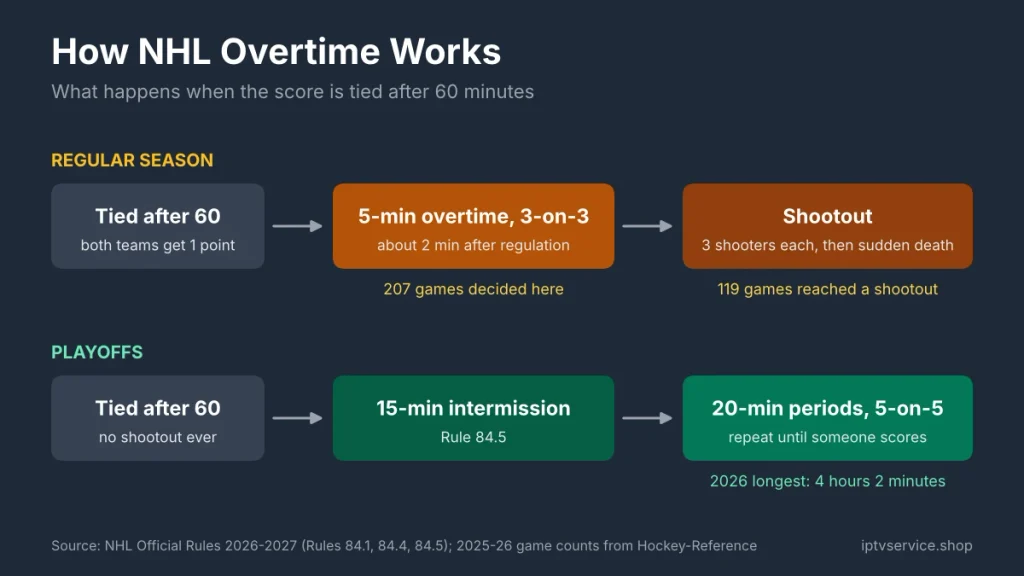
Regular-season overtime ends in 5 minutes or a shootout. Playoff overtime has no time limit
Regular Season: 3-on-3 and the Shootout
If the score is tied after 60 minutes, both teams get one point in the standings. Then comes overtime under Rule 84.1:
Length: up to 5 minutes of sudden death. The first goal wins and earns an extra point.
Players: three skaters plus a goalie per side.
Break before it: there is no intermission. The rule expects overtime to start about two minutes after regulation. Players stay at their benches.
Ends: teams change ends for overtime.
If nobody scores in those 5 minutes, Rule 84.4 sends the game to a shootout. Each team takes three shots and if it is still tied the shootout goes to sudden death. No player can shoot twice until everyone eligible has shot. The winner gets one goal added to its final score.
This also settles a common question: can an NHL game end in a tie? No. Overtime and the shootout guarantee a winner in every regular-season game.
Playoffs: 20-Minute Sudden Death
Playoff hockey never uses a shootout. New to the postseason? See how the NHL playoff format works before the first puck drop. Under Rule 84.5 the teams take a 15-minute intermission after regulation, then play full 20-minute periods with five skaters until someone scores.
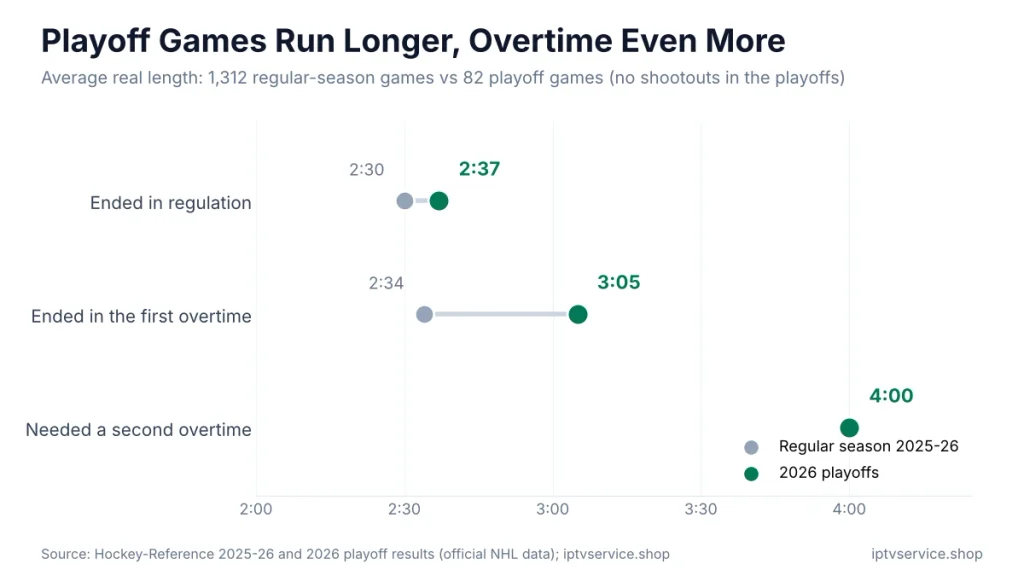
That is why playoff games run longer. Here is what the data shows for all 82 games of the 2026 Stanley Cup Playoffs.
2026 playoff games
Games
Average length
Longest
Ended in regulation
60
2:37
2:52
Ended in the first overtime
18
3:05
3:33
Needed a second overtime
4
4:00
4:02
All playoff games
82
2:47
4:02
Source: Hockey-Reference 2026 playoff results (official NHL data); calculations by iptvservice.shop, verified October 2026
A playoff game that reaches overtime ran about half an hour longer than one decided in regulation
Two things stand out. First, even playoff games without overtime ran 7 to 8 minutes longer than regular-season regulation games (2:37 vs 2:30). Second, a single overtime period added about half an hour of real time. The longest game was Dallas at Minnesota on April 22, 2026. Dallas won 4-3 in double overtime after 4 hours 2 minutes.
Truly long nights are rarer but they happen. When Florida beat Carolina in four overtimes in 2023, NHL.com noted the 15-minute intermissions between overtime periods that teams used to refuel players.
What Is the Longest NHL Game Ever?
The longest NHL game ever was a 1936 playoff game between the Detroit Red Wings and the Montreal Maroons. It lasted 176 minutes and 30 seconds of playing time across six overtimes before Mud Bruneteau scored for a 1-0 Detroit win.
Here are the six longest NHL games by playing time. All of them came in the playoffs.
Put that record next to our data and it looks even stranger. The 1936 game had almost three times the playing time of a normal game. A regular-season game today has a hard cap of 65 minutes of hockey plus a shootout.
How Long Are Hockey Games at Other Levels?
Olympic and high school hockey change mainly in overtime and high school games are shorter. The table compares what happens when a game is tied.
Level
Break before overtime
Overtime
Shootout
NHL regular season
About 2 min, no intermission
Up to 5 min, 3-on-3
Yes: 3 shooters each, then sudden death
NHL playoffs
15 min
20-min periods, 5-on-5, until a goal
No
2026 Olympics, preliminary round
3 min
Up to 5 min, 3-on-3
Yes: 5 shooters each, then one at a time
2026 Olympics, playoff games before the final
3 min
Up to 10 min, 3-on-3
Yes: 5 shooters each, then one at a time
2026 Olympics, gold medal game
18 min between periods
20-min 3-on-3 periods until a goal
No
US high school (NFHS)
3 min
8 min sudden death; states may use other rules
Not in the national rules
Source: NHL Official Rules 2026-2027, IIHF 2026 men’s Olympic tournament rules, NBC Olympics and the NFHS ice hockey rules summary, verified October 2026
How Long Is an Olympic Hockey Game?
The big difference at the Olympics is overtime. According to the IIHF’s 2026 men’s Olympic tournament rules, a tied gold medal game keeps going in 20-minute sudden-death periods with no shootout. NBC Olympics explained that those periods are played 3-on-3.
A high school game has 51 minutes of play instead of 60. Under the national high school (NFHS) rules summary each period is 17 minutes and the NFHS recommends a 12-minute intermission between periods. If a game is tied, the rule allows a 3-minute break and then an 8-minute sudden-death overtime. State associations can adopt other overtime policies, so check with your state or the school before game night.
How Long Do Professional Hockey Games Last?
When people ask how long pro hockey games last, they usually mean the NHL. The answer is our 2:32 average. Other professional leagues set their own overtime rules, so their real length can differ. We left them out because we could not confirm their current rules from an official source.
Planning Your Night Around an NHL Game
Three numbers do most of the work, whether you are at the arena or on the couch:
Plan for 2.5 hours after puck drop. Three out of four games end in regulation and those averaged 2:30.
Add 15 minutes if the game is tied late. Shootout games averaged 2:44.
For the playoffs, plan for open-ended. There is no cap on overtime. The four double-overtime games of 2026 averaged four hours.
Missed a late game? Many services offer replays. Our guide to what video on demand is explains how replays and catch-up viewing work.
Frequently Asked Questions
What time does a 7 p.m. hockey game end?
A 7 p.m. NHL game usually ends around 9:40 p.m. local time. The puck drops about 8 to 10 minutes after the listed start and a regulation game then lasts about 2:30. A shootout pushes the end closer to 9:55 p.m.
How long is an NHL period in real time?
An NHL period has 20 minutes of play but takes about 38 minutes of real time. That comes from the 150-minute average regulation game minus 36 minutes of intermissions, split across three periods.
How long are intermissions in the NHL?
NHL intermissions are 18 minutes long under Rule 34.2 of the NHL Official Rules 2026-2027. In the playoffs the break before overtime is 15 minutes under Rule 84.5.
How long is overtime in ice hockey?
In the NHL regular season overtime lasts up to 5 minutes with three skaters per side. In the NHL playoffs it is played in full 20-minute periods until someone scores. At the 2026 Olympics it was 5 minutes in the preliminary round, 10 minutes in later playoff games and unlimited in the gold medal game.
What is the 3-on-3 rule in hockey?
The 3-on-3 rule means each team plays overtime with three skaters and a goalie instead of five skaters. The NHL uses it in regular-season overtime. In 2025-26 almost two out of three overtime games ended with a goal before a shootout was needed.
Can an NHL game end in a tie?
No. A regular-season game that is still tied after 5 minutes of overtime goes to a shootout. Playoff games continue until a goal is scored. In the regular season both teams keep the one point they earned for reaching overtime.
How long is an NHL playoff game?
A playoff game that ends in regulation takes about 2 hours 37 minutes. In the 2026 playoffs the average across all 82 games was 2:47 and games that needed a second overtime averaged four hours.
The Bottom Line on How Long NHL Games Are
So how long are NHL games? Plan for about two and a half hours. All 1,312 regular-season games of 2025-26 averaged 2:32, with regulation games at 2:30, overtime games at 2:34 and shootout games at 2:44. Most of the extra time comes from two 18-minute intermissions and about 54 minutes of stoppages and TV breaks.
Next time you set a recording or book a ride home, use the start-time chart above. If you are planning to follow a whole season, our guide to alternatives to cable TV is a good next read. What is the longest game you have ever sat through? Tell us in the comments.
Kevin Brooks is an IPTV analyst and professional review writer with more than 11 years of experience in evaluating live TV and streaming platforms.
He specializes in reviewing IPTV services based on stability, channel availability, and device compatibility. Kevin’s reviews often include practical insights drawn from hands-on testing, making them highly valuable for users seeking reliable streaming solutions.


2 Responses