Most sports split a game into halves or quarters. Ice hockey does neither, which is why “how many periods in hockey” is one of the first things new fans look up. Here is the quick answer, the reason behind it and what a full NHL season of goals says about each period.
There are three periods in ice hockey. In the NHL each period has 20 minutes of game clock, so regulation is 60 minutes with two intermissions in between. If the score is tied after three periods, regular-season games add a five-minute 3-on-3 overtime and then a shootout. Playoff games add full 20-minute periods until someone scores.
Key Takeaways
Ice hockey has 3 periods of 20 minutes at the pro level, with 2 intermissions. There are no quarters or innings. (Field hockey is different: it uses four quarters.)
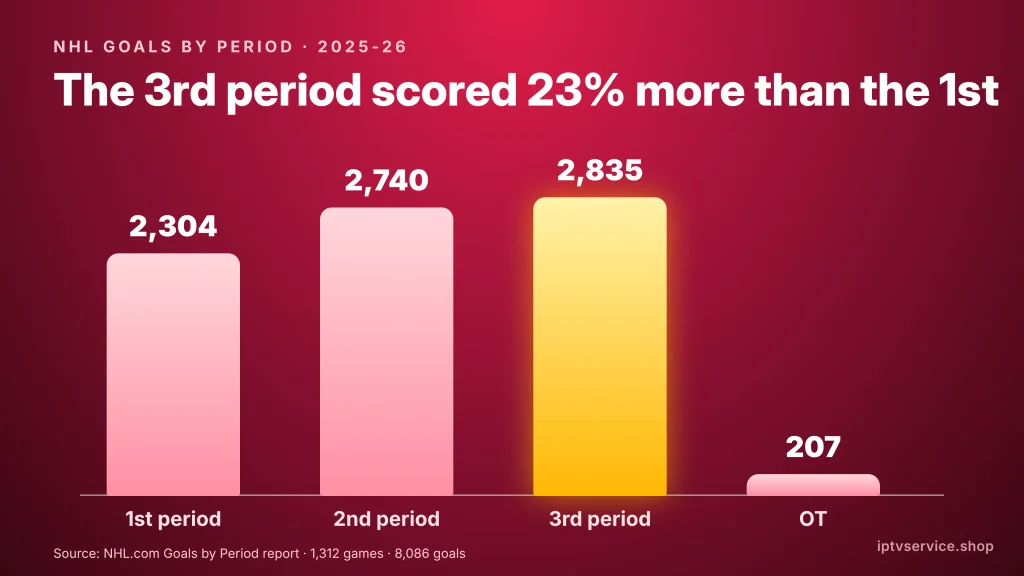
The periods share the same clock but not the same scoring. In 2025-26 the 3rd period produced 2,835 NHL goals, 23% more than the 1st period (2,304).
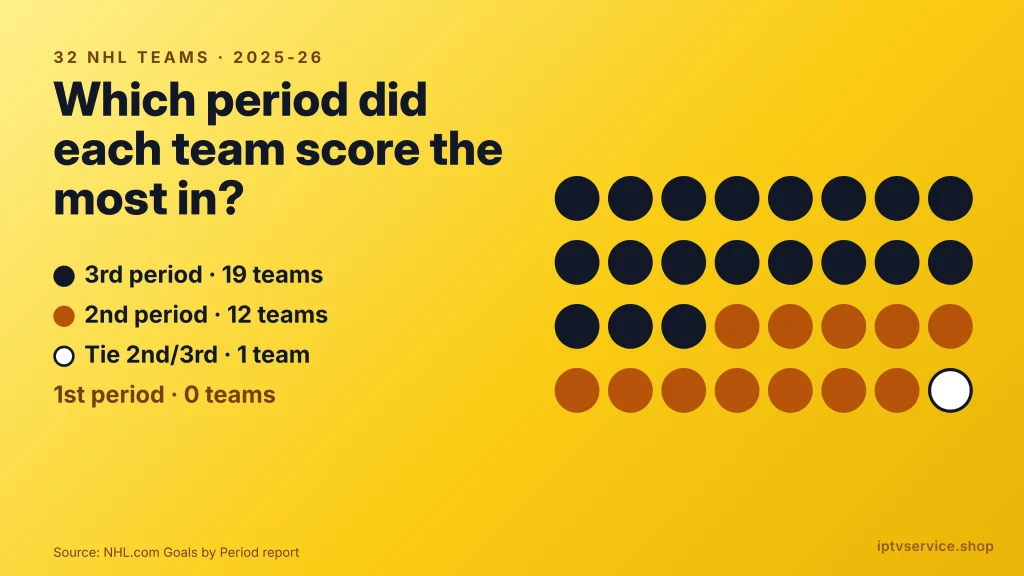
Not one of the 32 NHL teams scored the most goals in the 1st period in the 2025-26 season.
About 1 in 4 NHL games (326 of 1,312) needed more than three periods to find a winner.
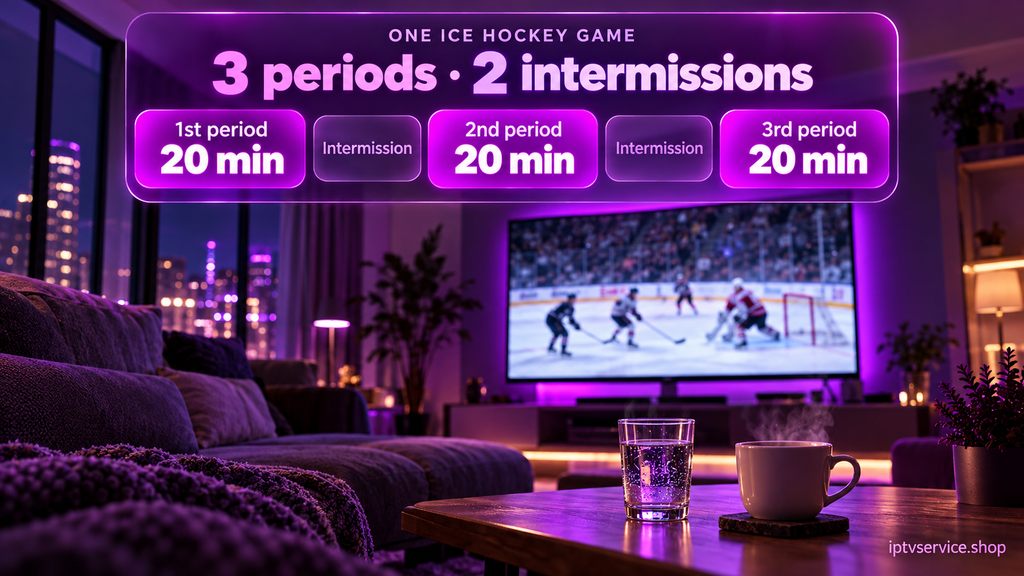
One NHL game: three 20-minute periods with an intermission after the 1st and 2nd.
How Many Periods Are in Hockey?
Ice hockey has three periods. In the NHL each one is 20 minutes of stop-time play, which adds up to 60 minutes of regulation.
A period is simply hockey’s name for one section of the game. The clock stops at every whistle, so a 20-minute period takes much longer in real life. Our guide to how long NHL games really last breaks down the real clock time.
The answer is the same in the NHL, the AHL, the PWHL, college hockey and the Olympics. High school and youth leagues also play three periods, but many make each one shorter. The table further down shows every level side by side.
Why Does Hockey Have 3 Periods Instead of Halves or Quarters?
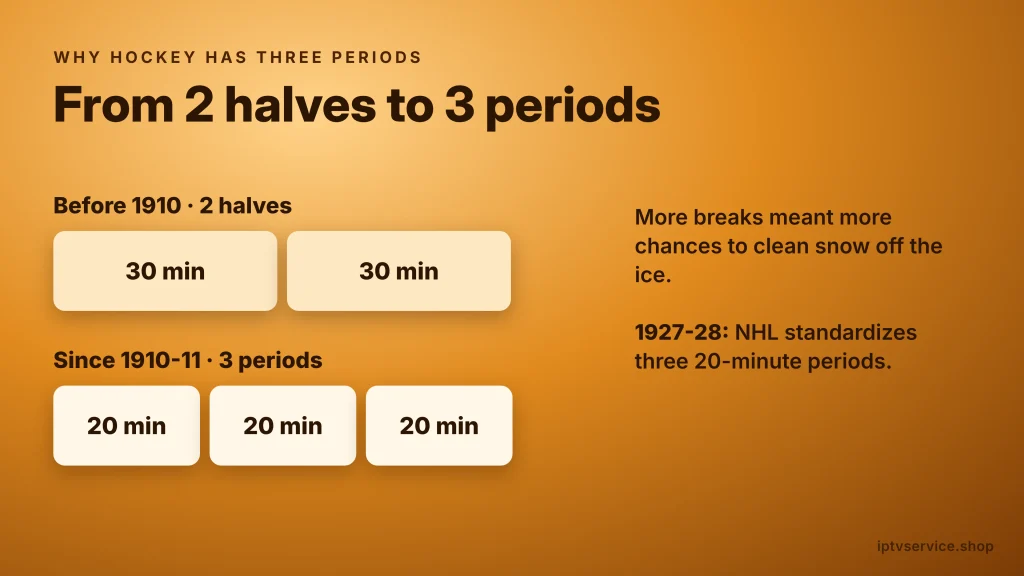
Hockey moved to three periods in 1910-11 to give the ice a break. Before that, games were played in two 30-minute halves.
Early rinks had no machines to clean the surface. Snow built up as players skated, the puck slowed down and the ice turned rough. Splitting the game into three parts gave rink crews two chances to clear the ice instead of one. NBC Sports Boston reports that, according to hockey legend, brothers Frank and Lester Patrick led the change. The extra break also gave players more rest.
The NHL later set the format in stone. Its historical rule changes list 1927-28 as the season when games were standardized at three 20-minute periods and teams began changing ends after each one.
Hockey moved from two 30-minute halves to three 20-minute periods in 1910-11.
So if you searched for innings in hockey or quarters in the NHL, the answer is none. Innings belong to baseball. Quarters belong to football, basketball and field hockey. Among the four big North American leagues, the NHL is the only one that plays in thirds.
Ice Hockey vs Field Hockey: Periods or Quarters?
Ice hockey has three periods. Field hockey has four quarters. If you live outside North America, “hockey” may mean field hockey, so the answer depends on which sport you mean.
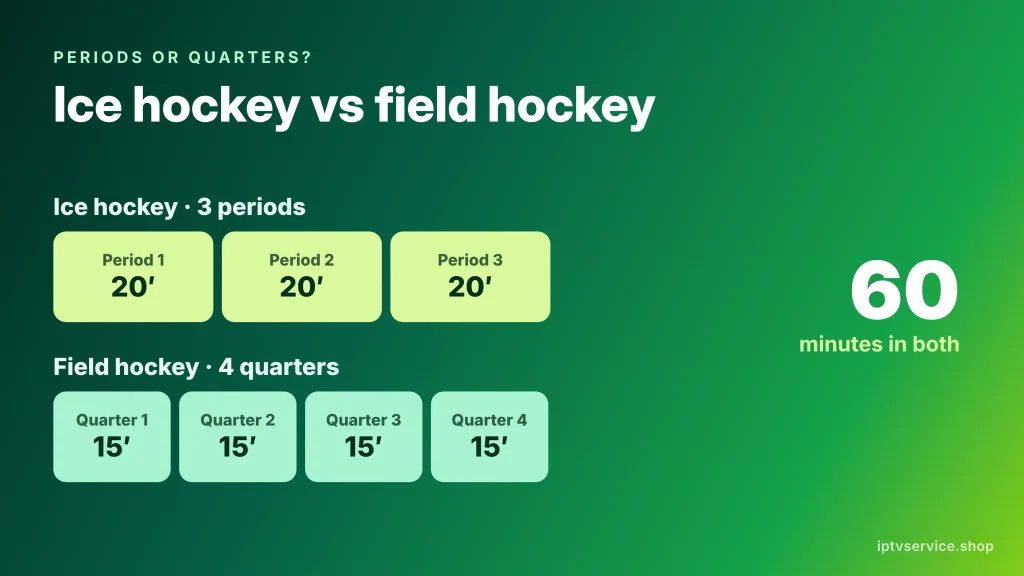
A field hockey match is four 15-minute quarters for 60 minutes in total. Olympics.com lists a 2-minute break after the 1st and 3rd quarters and a 15-minute half-time after the 2nd. The FIH switched to this format in 2014. Before that, field hockey used two 35-minute halves.
Ice hockey with three 20-minute periods compared with field hockey with four 15-minute quarters
Sport
Parts of the game
Minutes each
Total playing time
Ice hockey (NHL)
3 periods
20
60 minutes
Field hockey (FIH)
4 quarters
15
60 minutes
Source: Scouting The Refs NHL rule history and FIH via Olympics.com, verified October 2026.
The rest of this guide covers ice hockey, the sport played in the NHL.
The 3 Periods Are Not Equal: What 8,086 NHL Goals Show
Every period gets the same 20 minutes, but they do not produce the same hockey. Across the 2025-26 NHL regular season, scoring rose with each period.
Period
Goals (2025-26)
Goals per game
Share of all goals
1st period
2,304
1.76
28.5%
2nd period
2,740
2.09
33.9%
3rd period
2,835
2.16
35.1%
Overtime
207
0.16
2.6%
Total
8,086
6.16
100%
Source: NHL.com Goals by Period report, 2025-26 regular season (1,312 games), verified October 2026. Shares are rounded.
The 3rd period produced 23% more goals than the 1st in the 2025-26 NHL season.
Three things stand out:
The 3rd period produced 531 more goals than the 1st period. That is a jump of 23%.
Not a single team scored the most goals in the 1st period. Of the 32 teams, 19 peaked in the 3rd period and 12 peaked in the 2nd. Los Angeles tied between the two with 76 goals in each.
The 1st period is the quietest stretch of the game at 1.76 goals per game.
No NHL team scored the most goals in the 1st period in 2025-26.
Why the 2nd Period Is Different: The Long Change
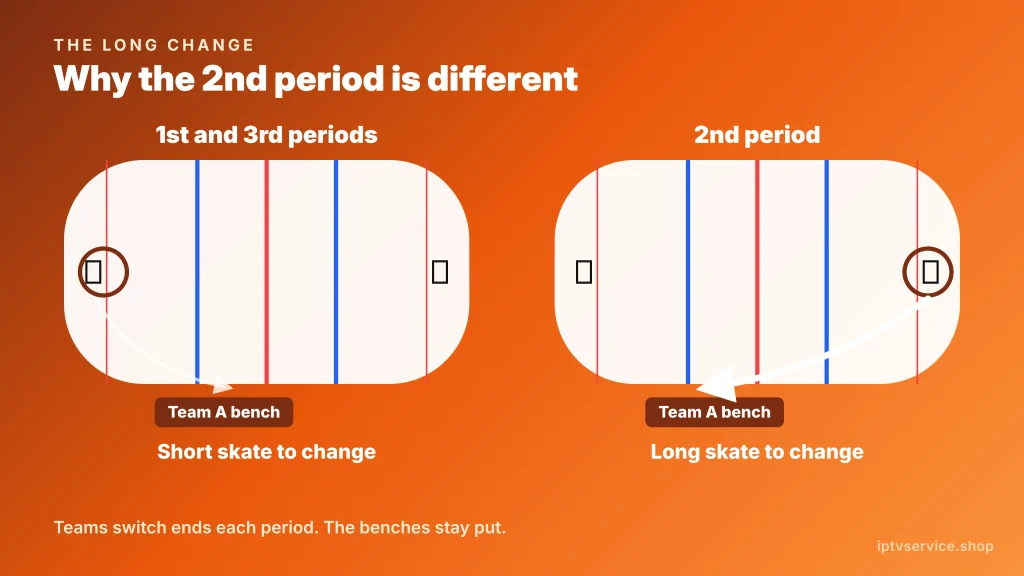
Teams switch ends after every period, but the benches stay where they are. In the 1st and 3rd periods each team defends the goal closest to its own bench. In the 2nd period it defends the far goal.
That means tired defenders must skate the length of the ice to change lines. Players get caught on the ice longer and mistakes follow. Hockey people call this the long change. It is the most common explanation for why the 2nd period out-scores the 1st by 436 goals a season.
In the 2nd period each team defends the goal farther from its own bench.
Why the 3rd Period Scores the Most
Two likely reasons explain it. A team that is behind takes more risks late in the game. It also often pulls its goalie for an extra skater, which leaves an empty net the other team can shoot at from far away.
The NHL report does not split empty-net goals by period. So we can show that the 3rd period scores the most, but we cannot measure how much each reason adds.
How We Collected This Data
We pulled the NHL’s official Goals by Period report for all 32 teams in the 2025-26 regular season (1,312 games) on October 13, 2026. We added up each team’s goals in each period. As a check, league-wide goals scored matched goals allowed in every period. Every team’s period totals also matched its season goal total. The report counts regulation and overtime goals only, so shootout goals are left out. You can view the same report on NHL.com’s team stats page.
Limits to Keep in Mind
This is one regular season. The pattern may look different in the playoffs, where overtime works another way.
The report counts goals, not chances. It shows where scoring happens but not exactly why.
Team style matters. Pittsburgh scored almost evenly across all three periods (93, 97 and 96 goals), unlike the league trend.
None of this changes the basic answer. It simply shows that the three periods feel different to watch.
What Happens Between Periods?
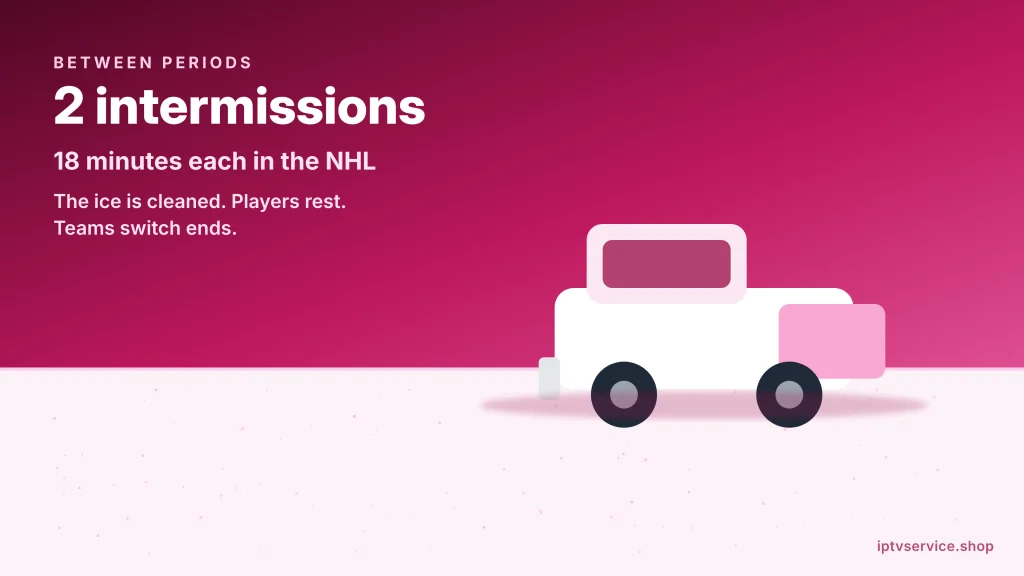
There are two intermissions in a hockey game: one after the 1st period and one after the 2nd. In the NHL each one lasts 18 minutes under Rule 34.2. During each break the ice is cleaned, players rest in the locker room and the teams switch ends for the next period.
NHL intermissions last 18 minutes each under Rule 34.2.
Those two breaks add 36 minutes to every game. Our NHL game length breakdown shows how they fit into the full night.
What Happens If the Game Is Tied After 3 Periods?
A tied NHL game gets more hockey. How much depends on whether it is the regular season or the playoffs.
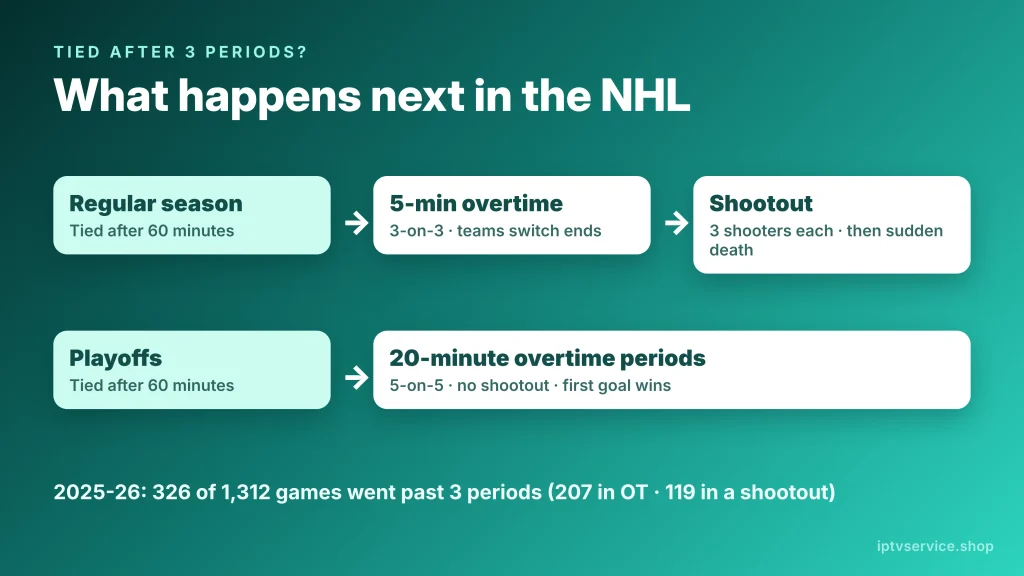
Regular season: One overtime period of up to five minutes with three skaters per side. Teams change ends before overtime under Rule 84.1 of the NHL Official Rules 2026-27, so overtime also has a long change. If it stays tied, a shootout follows with three shooters per team, then sudden-death rounds.
Playoffs: No shootouts. Teams play full 20-minute periods until someone scores, as NHL.com explains.
Extra periods are more common than many fans expect. In 2025-26, 326 of 1,312 NHL games (24.8%) went past three periods. Of those, 207 ended in overtime and 119 went to a shootout.
Regular-season ties go to 3-on-3 overtime and a shootout. Playoff ties go to full 20-minute periods. Here is how the NHL playoffs work, from the 16-team bracket to overtime.
How Many Periods in Hockey at Other Levels?
Every major level of ice hockey plays three periods. What changes is the length of each period and how a tie is settled.
Level
Periods
Minutes per period
Regular-season tie after regulation
NHL
3
20
5-minute 3-on-3 overtime, then a shootout
AHL
3
20
5-minute 3-on-3 overtime, then a shootout
PWHL (women’s pro)
3
20
5-minute 3-on-3 overtime, then a shootout
NCAA college (men’s and women’s)
3
20
5-minute 3-on-3 overtime; a shootout only in some games
IIHF events incl. the Olympics (preliminary round)
3
20
5-minute 3-on-3 overtime, then a shootout
High school (New Jersey example)
3
15
One 5-minute overtime; still tied ends as a tie
Youth leagues
3
Varies by age group
Set by each league
Source: NHL.com, FloHockey (AHL, April 2025), PWHL rulebook announcement (January 2024), Duluth News Tribune via Brainerd Dispatch (NCAA, 2020-21 rule), IIHF Official Rule Book 2026-27 and NJSIAA 2025-26 ice hockey rules, verified October 2026.
A few details are worth knowing:
College hockey: The 3-on-3 overtime applies to both men’s and women’s NCAA games. The three-round shootout is used only in conference games and regular-season tournaments. The NCAA tournament uses 20-minute 5-on-5 overtime periods.
Olympics: The IIHF Official Rule Book uses the same three 20-minute periods. Overtime gets longer in later rounds under IIHF rules and each tournament’s own guidelines.
High school: The national NFHS rules set 17-minute periods, but each state association can change them. New Jersey’s NJSIAA rules use three 15-minute periods, so check your own state’s association.
Youth hockey: Kids still play three periods, but local leagues often shorten them for younger age groups.
Timeouts and the Gretzky Rule
Each team gets one 30-second timeout per game under NHL Rule 87.1. The NHL first added the timeout in 1983-84.
What Is the Gretzky Rule?
The Gretzky rule was a 1985-86 NHL change that let teams replace players serving coincidental minor penalties and stay 5-on-5 instead of playing 4-on-4. Fans tied it to Wayne Gretzky’s Edmonton Oilers, a team that thrived with open ice. The NHL reversed it for 1992-93, so the rule no longer exists.
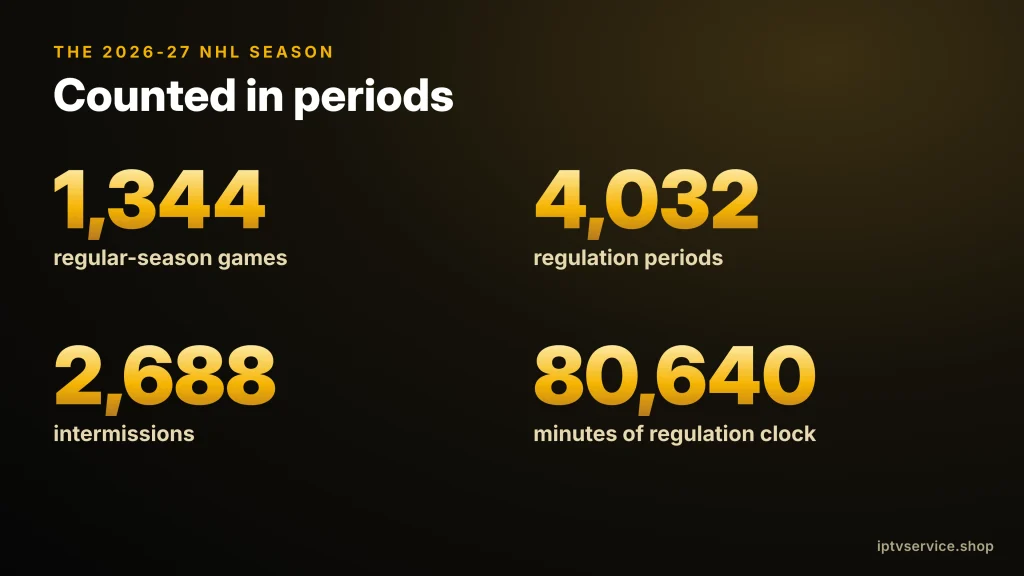
That is 80,640 minutes of regulation game clock before a single overtime is played.
The 84-game 2026-27 season adds up to 4,032 regulation periods.
Frequently Asked Questions
How many 20-minute periods are in hockey?
There are three 20-minute periods in the NHL, the AHL, the PWHL, college hockey and Olympic hockey. That makes 60 minutes of regulation. High school and youth games also have three periods, but they are often shorter.
Are there quarters or innings in hockey?
Ice hockey has neither. It is played in three periods. Field hockey is the exception: it uses four 15-minute quarters. Innings belong only to baseball.
How many intermissions are in a hockey game?
A regulation hockey game has two intermissions. One comes after the 1st period and one comes after the 2nd. Each lasts 18 minutes in the NHL. In the playoffs another intermission comes before each overtime period.
How many periods are in hockey overtime?
In the NHL regular season, overtime is one period of up to five minutes, followed by a shootout if needed. In the playoffs there is no limit. Teams play 20-minute periods until someone scores.
How many periods are in college hockey?
College hockey has three 20-minute periods, just like the NHL. Tied regular-season games go to a five-minute 3-on-3 overtime. Some games then use a three-round shootout.
Which period has the most goals in hockey?
In the 2025-26 NHL regular season, the 3rd period had the most goals with 2,835. The 2nd period had 2,740 and the 1st period had 2,304.
The Bottom Line
How many periods in hockey? Ice hockey has three at every major level, each 20 minutes in the pros. Field hockey uses four quarters instead. The three ice hockey periods run on the same clock, but they are not equal: the 2nd period brings the long change and the 3rd period brings the most goals.
Next, see how the 84-game NHL schedule shapes the 2026-27 season in our guide to how many NHL games are in a season. Which period do you find the most exciting to watch? Tell us in the comments.
Kevin Brooks is an IPTV analyst and professional review writer with more than 11 years of experience in evaluating live TV and streaming platforms.
He specializes in reviewing IPTV services based on stability, channel availability, and device compatibility. Kevin’s reviews often include practical insights drawn from hands-on testing, making them highly valuable for users seeking reliable streaming solutions.


3 Responses