
Last updated: October 14, 2026
Half the NHL makes the playoffs every spring. That sounds generous until you look at who actually wins once they get there.
Here is the short answer to how many NHL teams make the playoffs, plus what most guides skip: how many points it really takes to get in and why wild-card teams almost never last.
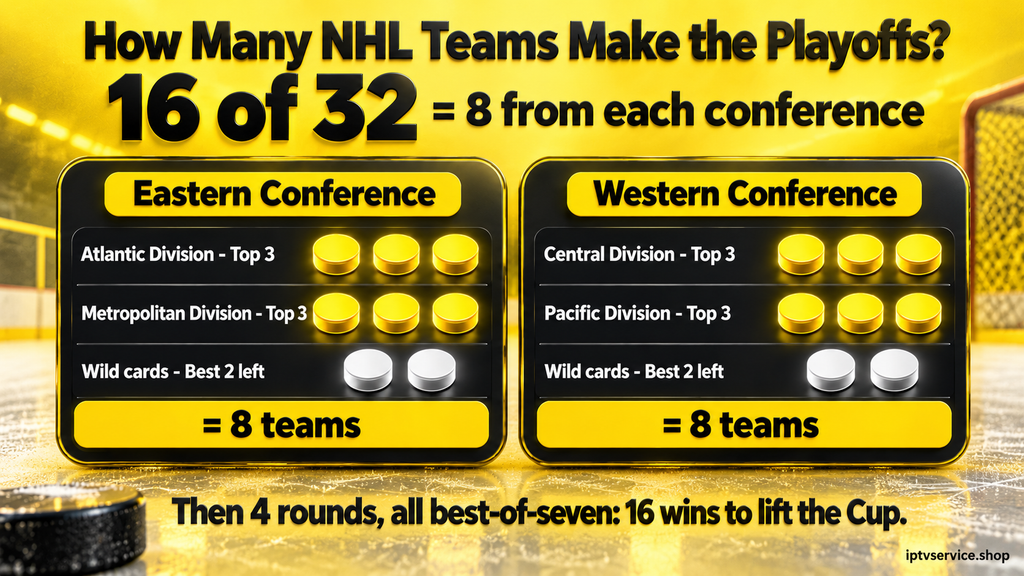
Sixteen of the NHL’s 32 teams make the playoffs: eight from each conference. The top three teams in each of the four divisions take 12 spots. The two best remaining teams in each conference get the four wild cards. All four rounds are best-of-seven, so the champion needs 16 wins.
Key Takeaways
- 16 of 32 teams qualify: 12 through their division and 4 as wild cards.
- In 22 wild-card races since 2014, no team with 97 or more points has missed. Four teams missed with 96.
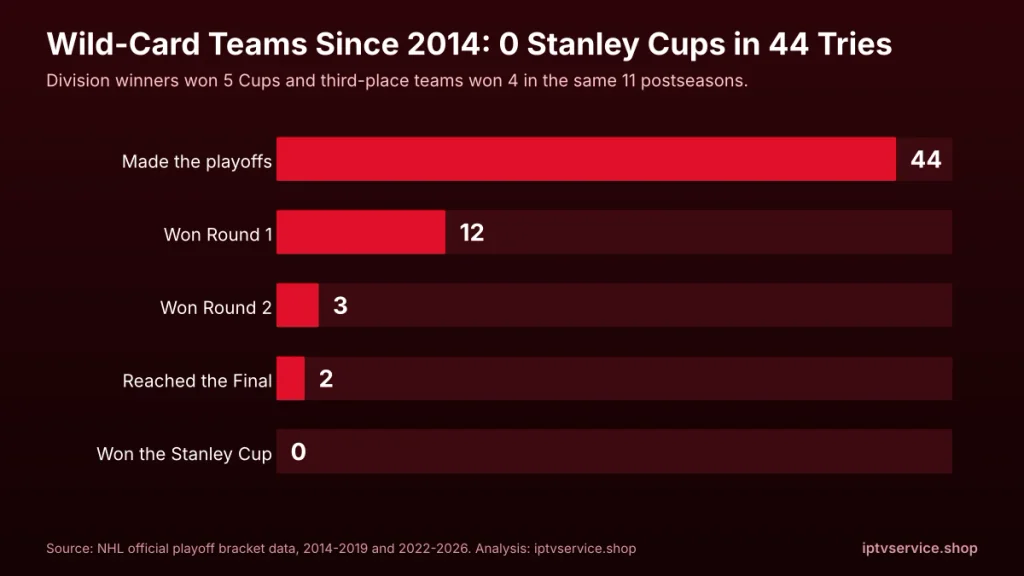
- Wild-card teams are 0 for 44 in Stanley Cup wins. Only two even reached the Final.
- The 2027 playoff dates are not announced yet. The regular season ends on Saturday, April 10, 2027.
How Many NHL Teams Make the Playoffs Each Year?
Sixteen teams make the NHL playoffs each year, which is exactly half the league. Each conference sends eight teams, so the Eastern and Western Conferences are always equal.
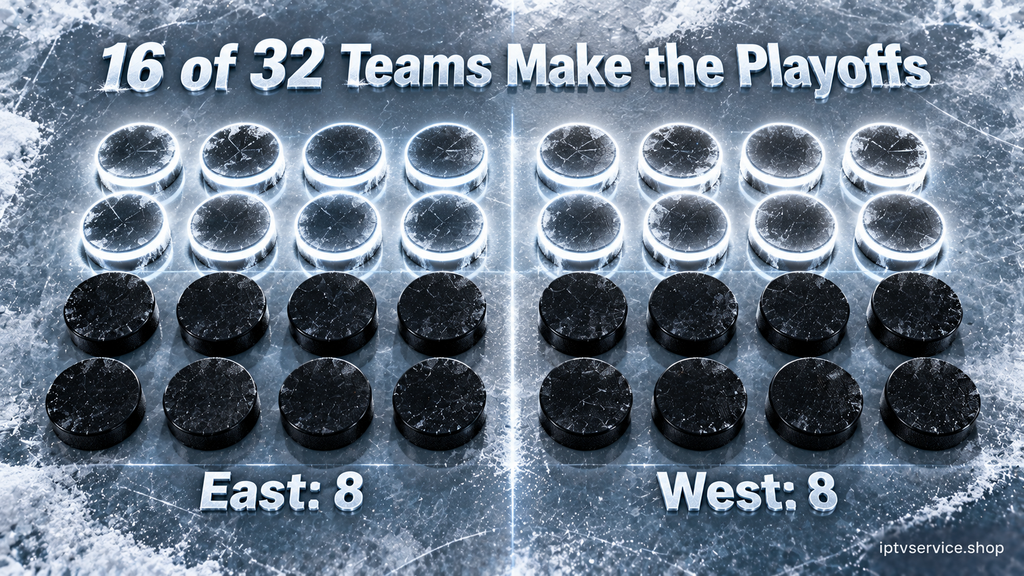
The NHL introduced this format in the 2013-14 season and still uses it after the move to an 84-game regular season in 2026-27. The only breaks came in 2020 and 2021, when the pandemic forced special formats without wild cards.
| Path into the playoffs | Spots | Who gets them |
|---|---|---|
| Top 3 in the Atlantic Division | 3 | Eastern Conference |
| Top 3 in the Metropolitan Division | 3 | Eastern Conference |
| Top 3 in the Central Division | 3 | Western Conference |
| Top 3 in the Pacific Division | 3 | Western Conference |
| Wild cards | 4 | Two per conference, from any division |
| Total | 16 | 8 per conference |
Because the wild cards can come from either division, one division in a conference can send five teams while the other sends three. Every division sends at least three.
How the NHL Compares With Other Leagues
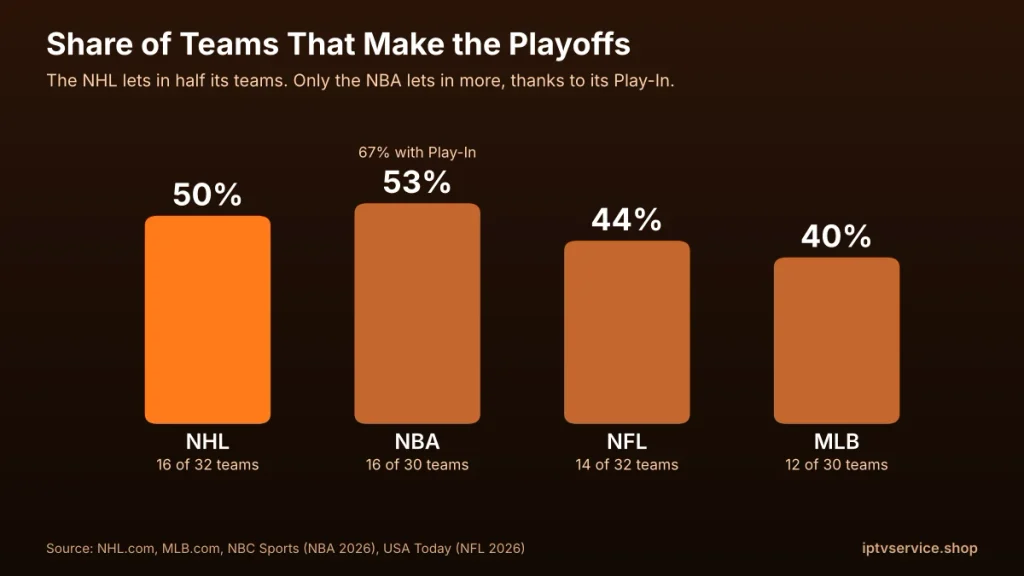
The NHL lets in a bigger share of its teams than the NFL or MLB.
| League | Teams | Playoff teams | Share |
|---|---|---|---|
| NHL | 32 | 16 | 50% |
| NBA | 30 | 16 (20 including the Play-In) | 53% (67% with Play-In) |
| NFL | 32 | 14 | 44% |
| MLB | 30 | 12 | 40% |
The NHL has no play-in round. Finish in the top 16 the right way and you are in. Finish 17th and your season is over.
How the NHL Playoff Format Works
The hockey playoff format in the NHL is four rounds of best-of-seven series inside a fixed bracket. Teams are not reseeded after each round, so your path is set the day the regular season ends.
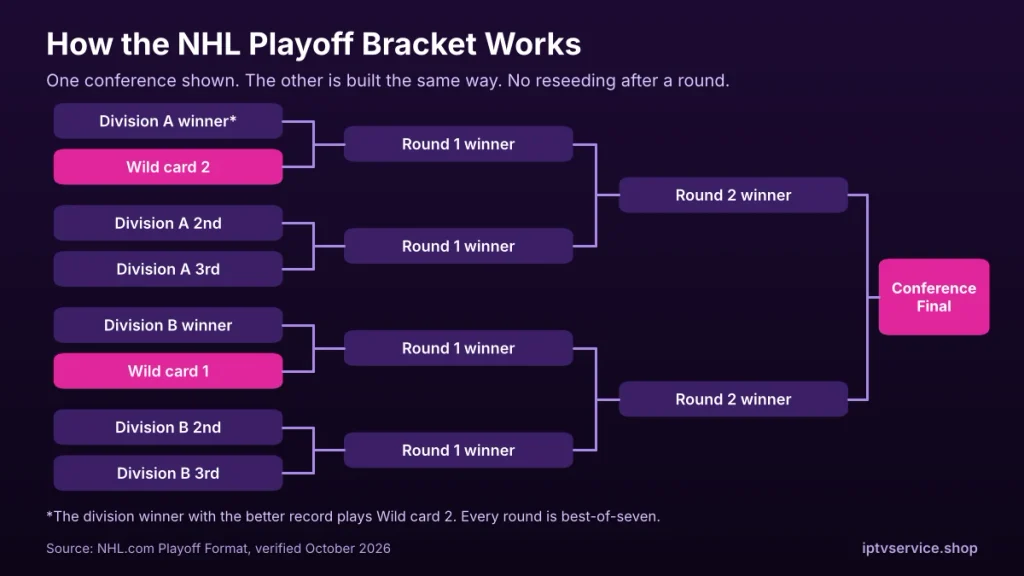
According to the NHL’s official playoff format, this is how the bracket is built.
How the Wild Card Works in the NHL
After the 12 division spots are filled, the NHL ranks every other team in the conference by points. The top two become the first and second wild cards (WC1 and WC2). Division does not matter for these spots.
Who Plays Whom in Round 1
- The division winner with the better record plays the second wild card (WC2).
- The other division winner plays the first wild card (WC1).
- In each division, the second-place team plays the third-place team.
So a wild card always starts on the road against a division winner. That is the hardest first-round draw in the bracket.
Home Ice and the 2-2-1-1-1 Schedule
In every round, home ice goes to the team that finished higher in the regular-season standings.
Home ice means games 1, 2, 5 and 7 at home. That is the 2-2-1-1-1 pattern, not 2-3-2. The 2026 Final followed it exactly: Games 1 and 2 in Carolina, 3 and 4 in Las Vegas, Game 5 in Carolina and Game 6 in Las Vegas.
What Happens When Teams Tie on Points
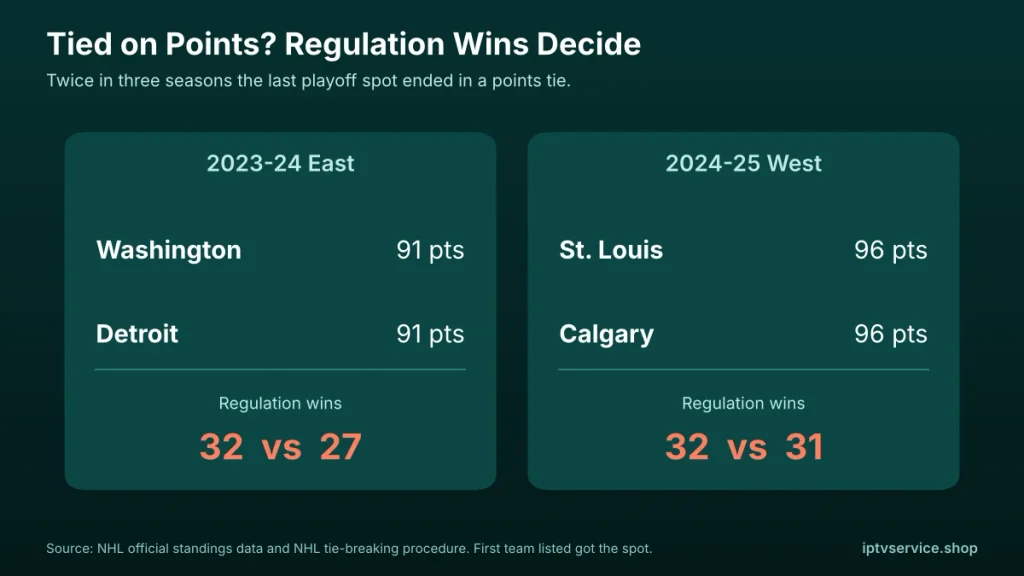
Ties are broken by the NHL tie-breaking procedure. The first test is fewer games played. Every team plays the same number by the last day, so the real decider is usually the second test: regulation wins, meaning wins that did not need overtime or a shootout.
This is not rare. The last playoff spot ended in a points tie twice in the past three seasons:
- 2023-24, East: Washington and Detroit both had 91 points. Washington got in with 32 regulation wins to Detroit’s 27.
- 2024-25, West: St. Louis and Calgary both had 96 points. St. Louis got in with 32 regulation wins to Calgary’s 31.
One regulation win separated a playoff team from a team on vacation.
How Many Points Does It Take to Make the NHL Playoffs?
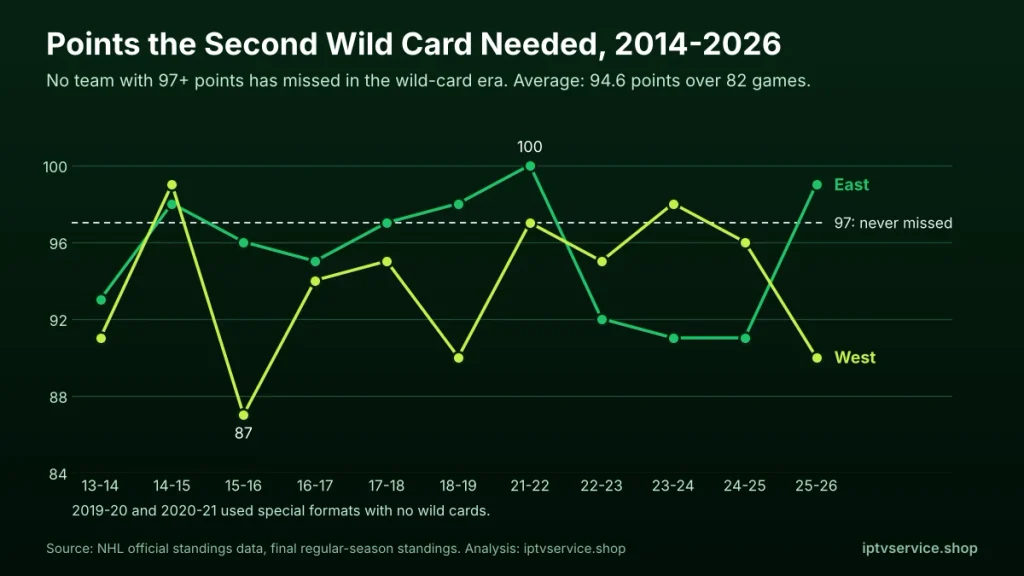
In the wild-card era the final playoff spot (the second wild card) has gone to a team with 94.6 points on average over 82 games. No team with 97 or more points has missed in the wild-card era. Four teams missed with 96.
We pulled the final standings for all 11 full wild-card seasons and wrote down the second wild card and the first team out in each conference. That makes 22 playoff races.
| Season | East: 2nd wild card | East: first team out | West: 2nd wild card | West: first team out |
|---|---|---|---|---|
| 2013-14 | Red Wings 93 | Capitals 90 | Stars 91 | Coyotes 89 |
| 2014-15 | Penguins 98 | Bruins 96 | Jets 99 | Kings 95 |
| 2015-16 | Flyers 96 | Bruins 93 | Wild 87 | Avalanche 82 |
| 2016-17 | Maple Leafs 95 | Islanders 94 | Predators 94 | Jets 87 |
| 2017-18 | Devils 97 | Panthers 96 | Avalanche 95 | Blues 94 |
| 2018-19 | Blue Jackets 98 | Canadiens 96 | Avalanche 90 | Coyotes 86 |
| 2021-22 | Capitals 100 | Islanders 84 | Predators 97 | Golden Knights 94 |
| 2022-23 | Panthers 92 | Penguins 91 | Jets 95 | Flames 93 |
| 2023-24 | Capitals 91 | Red Wings 91 | Golden Knights 98 | Blues 92 |
| 2024-25 | Canadiens 91 | Blue Jackets 89 | Blues 96 | Flames 96 |
| 2025-26 | Senators 99 | Capitals 95 | Kings 90 | Blues 86* |
A third-place team in a division can occasionally finish with fewer points than the second wild card. In 2025-26, Philadelphia got in as third in the Metropolitan with 98 points, one fewer than wild-card Ottawa.
What the table shows:
- 97 points has always been enough. No team that reached 97 points missed the playoffs in these 22 races.
- 96 points has failed four times: Boston in 2014-15, Florida in 2017-18, Montreal in 2018-19 and Calgary in 2024-25.
- The bar moves a lot. The lowest second-wild-card total was 87 points (Minnesota, West, 2015-16). The highest was 100 (Washington, East, 2021-22).
- Races are tight. In 11 of the 22 races, the second wild card finished two points or fewer ahead of the first team out.
What changes with 84 games? Two extra games mean more points for everyone. The NHL has not published a new target. As a rough estimate, the average of 94.6 points over 82 games works out to about 97 points over 84 games (94.6 ÷ 82 × 84 = 96.9).
How We Collected This Data
We used the NHL’s official public stats feed (api-web.nhle.com): final standings for each season and the playoff bracket for each year. We covered the 11 postseasons that used wild cards (2014 to 2019 and 2022 to 2026). We left out 2020 and 2021 because those seasons used special formats with no wild cards. The playoff seeds in the bracket matched the wild-card teams in the standings for every season. Data pulled October 14, 2026.
Has a Wild Card Team Ever Won the Stanley Cup?
No. Since wild cards began in 2014, 44 wild-card teams have made the playoffs and none has won the Stanley Cup. Two reached the Final and both lost: Nashville in 2017 and Florida in 2023.
CBS Sports also described Florida as only the second wild card to reach the Final under this format. The closest thing to a wild-card champion came before this format: the 2012 Los Angeles Kings won the Cup as the West’s No. 8 seed, the lowest seed ever to win it.
Here is how every seed has done over the same 11 postseasons:
| Seed | Teams | Won Round 1 | Won Round 2 | Reached Final | Won Cup |
|---|---|---|---|---|---|
| Division winner | 44 | 32 | 15 | 7 | 5 |
| 2nd in division | 44 | 26 | 16 | 6 | 2 |
| 3rd in division | 44 | 18 | 10 | 7 | 4 |
| First wild card | 22 | 8 | 1 | 0 | 0 |
| Second wild card | 22 | 4 | 2 | 2 | 0 |
Three things stand out:
- Wild cards win only about one first-round series in four. Against division winners they are 12 wins and 32 losses (27%).
- Third place is a real threat. Third-place teams won four Cups, nearly as many as division winners (five). Second-place teams won only two.
- Upsets happen early. Third-place teams beat second-place teams in 18 of 44 first-round series (41%).
Every Stanley Cup Champion of the Wild-Card Era
| Year | Champion | Seed | Beat in the Final | Series |
|---|---|---|---|---|
| 2014 | Los Angeles Kings | 3rd in division | New York Rangers (2nd) | 4-1 |
| 2015 | Chicago Blackhawks | 3rd in division | Tampa Bay Lightning (2nd) | 4-2 |
| 2016 | Pittsburgh Penguins | 2nd in division | San Jose Sharks (3rd) | 4-2 |
| 2017 | Pittsburgh Penguins | 2nd in division | Nashville Predators (wild card) | 4-2 |
| 2018 | Washington Capitals | Division winner | Vegas Golden Knights (division winner) | 4-1 |
| 2019 | St. Louis Blues | 3rd in division | Boston Bruins (2nd) | 4-3 |
| 2022 | Colorado Avalanche | Division winner | Tampa Bay Lightning (3rd) | 4-2 |
| 2023 | Vegas Golden Knights | Division winner | Florida Panthers (wild card) | 4-1 |
| 2024 | Florida Panthers | Division winner | Edmonton Oilers (2nd) | 4-3 |
| 2025 | Florida Panthers | 3rd in division | Edmonton Oilers (3rd) | 4-2 |
| 2026 | Carolina Hurricanes | Division winner | Vegas Golden Knights (division winner) | 4-2 |
The most recent champion was Carolina. The Hurricanes beat Vegas in six games in June 2026 and finished the playoffs 16-3.
How Long Is the Road to the Stanley Cup?
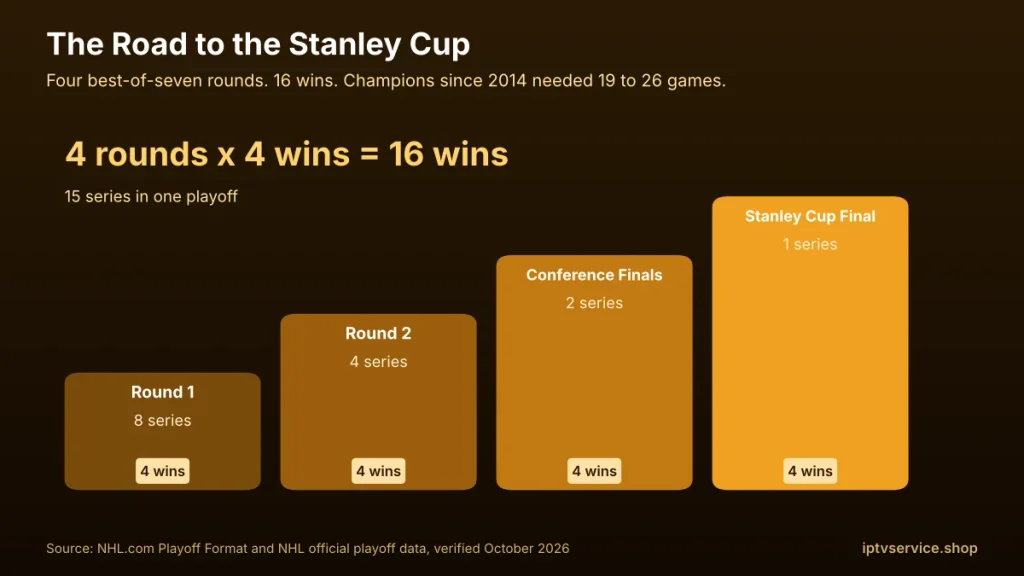
The Stanley Cup goes to the team that wins four best-of-seven series in a row: 16 wins in total. One full playoff has 15 series and anywhere from 60 to 105 games.
- Round 1: 8 series
- Round 2: 4 series
- Conference Finals: 2 series
- Stanley Cup Final: 1 series
The champion needs 16 wins and plays between 16 and 28 games. In real life nobody has come close to the minimum lately. Champions in the wild-card era played 19 to 26 games. Carolina’s 19 games in 2026 were the fewest in that span.
The real numbers from the 11 wild-card postseasons:
- 165 series produced 964 games, about 88 games per postseason.
- 48 series went to a Game 7 (29%).
- 20 series were sweeps (12%).
- Six games was the most common length: 63 of the 165 series.
NHL Playoff Overtime Rules
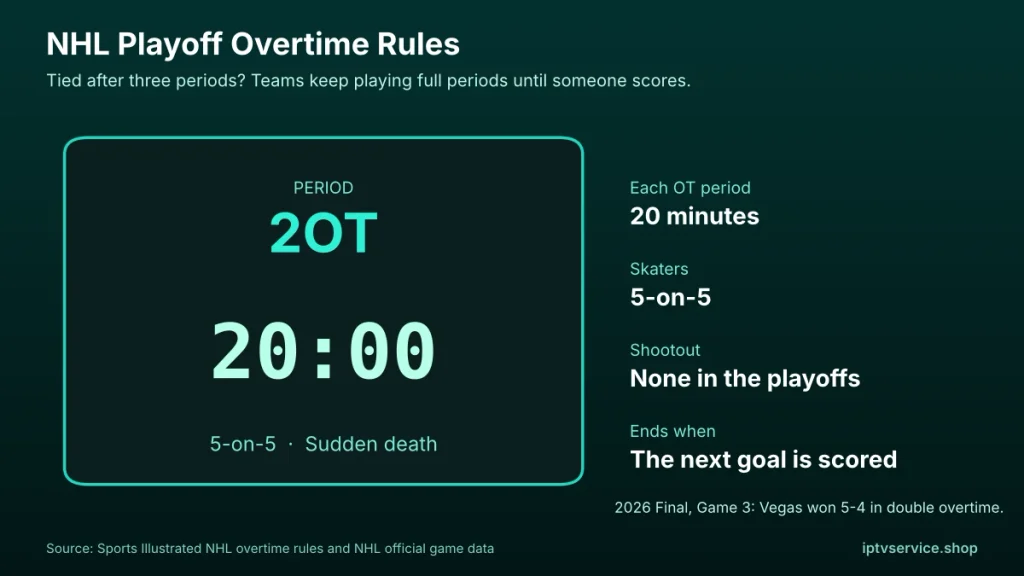
If a playoff game is tied after three periods, teams play full 20-minute overtime periods at 5-on-5 until someone scores. There is no shootout in the playoffs, so a game can last two, three or more extra periods.
This is very different from the regular season, which uses a short 3-on-3 overtime and then a shootout. Our guide to regular-season overtime and shootout rules explains that part.
Sports Illustrated’s overtime explainer sums up the playoff rule simply: sudden death, 5-on-5 and no shootouts. Game 3 of the 2026 Final needed a second overtime before Vegas won 5-4. Extra periods also push back the clock, which is why playoff games often run past how long a hockey game normally lasts.
When Do the 2027 Stanley Cup Playoffs Start?
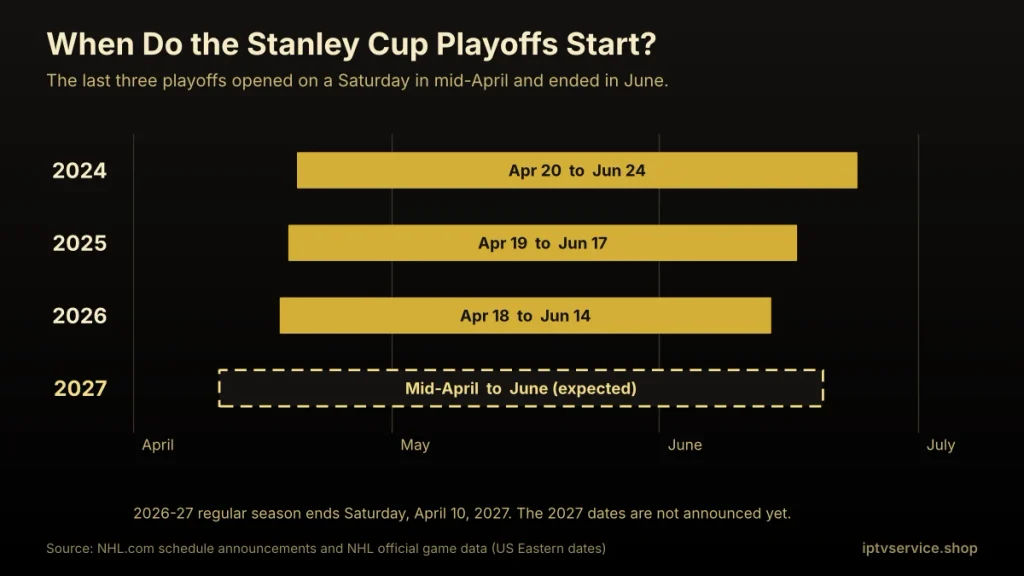
The NHL has not announced the 2027 playoff schedule yet. The 2026-27 regular season ends on Saturday, April 10, 2027, so the playoffs are expected to begin in mid-April.
The last three seasons show a clear pattern:
| Playoffs | Round 1 began | Final Game 1 | Cup decided | Length |
|---|---|---|---|---|
| 2024 | Sat, April 20 | June 8 | June 24 (Game 7) | 66 days |
| 2025 | Sat, April 19 | June 4 | June 17 (Game 6) | 60 days |
| 2026 | Sat, April 18 | June 2 | June 14 (Game 6) | 58 days |
| 2027 (expected) | Mid-April | Late May or early June | June | About 2 months |
In all three years the playoffs opened on a Saturday. The Final started 45 to 49 days after Round 1 began. That puts the expected 2027 Stanley Cup Finals date in late May or early June. We will update this section when the NHL releases the 2027 schedule, usually in April.
NHL Playoffs TV Schedule: What Channel Are the 2027 Playoffs On?
In the United States, ESPN/ABC and TNT share the 2027 playoffs. They split the first two rounds, each network has one Conference Final and TNT has the 2027 Stanley Cup Final.
| Round | US TV (2027) |
|---|---|
| Round 1 | Split between ESPN/ABC and TNT |
| Round 2 | Split between ESPN/ABC and TNT |
| Conference Finals | One on ESPN/ABC, one on TNT |
| Stanley Cup Final | TNT |
Which Conference Final goes to which network has not been announced yet. The Final alternates every year. ABC had it in 2024 and 2026. TNT had it in 2025 and has it again in 2027. In 2026, TNT playoff games also streamed on HBO Max and ESPN and ABC games on the ESPN app, according to Sports Media Watch. Check again closer to April, since 2027 streaming details are not announced yet.
In Canada, Sportsnet carries the 2027 Final. CBC no longer airs NHL games starting in 2026-27, after its deal with Rogers ended, The Canadian Press reported. Use legal, licensed services and check the rules where you live.
Is the NHL Playoff Format Fair? The Main Criticisms
The format is simple and gives every division at least three teams. It also has a few weak spots that fans argue about every spring.
- The two conferences can be uneven. In 2015-16, Minnesota made it in the West with 87 points while Boston missed in the East with 93. In 2025-26, Los Angeles got in with 90 while Washington missed with 95.
- Strong teams can meet in Round 1. The second- and third-place teams in a division always play each other. In 2026, Tampa Bay and Montreal both finished with 106 points and had to face each other in Round 1, while Vegas won the Pacific with 95.
- The wild-card road is brutal. A wild card starts on the road against a division winner and has not won a Cup in 44 tries.
- One win can decide a season. Twice in three years the last spot came down to regulation wins.
None of this changes the main promise: finish in your division’s top three or win a wild-card race and you have a real shot. Third-place teams have won four of the 11 Cups in the wild-card era.
Frequently Asked Questions
How many wild card teams make the NHL playoffs?
Four. Each conference gets two wild cards: the two best teams that did not finish in the top three of their division. They can come from either division.
How many NHL teams make the playoffs per conference?
Eight. Each conference has two divisions. The top three teams from each division qualify. Then the two best remaining teams in the conference get the wild cards.
How many NHL teams make the playoffs from each division?
At least three. The top three in every division qualify automatically. Because the wild cards can come from either division, one division can send five teams while the other in that conference sends three.
Is the NHL playoff format 2-3-2?
No. The NHL uses 2-2-1-1-1. The team with home ice hosts Games 1, 2, 5 and 7. The other team hosts Games 3, 4 and 6.
How many games are in the Stanley Cup Final?
Up to seven. The Final is best-of-seven like every other round, so the first team to win four games takes the Cup. The 2026 Final went six games.
Who has won the most Stanley Cups?
The Montreal Canadiens, with 24 Stanley Cups according to NHL.com. No other team has more.
Which teams made the 2026 NHL playoffs?
East: Buffalo, Boston, Tampa Bay, Montreal, Carolina, Ottawa, Pittsburgh and Philadelphia. West: Colorado, Los Angeles, Dallas, Minnesota, Vegas, Utah, Edmonton and Anaheim. Carolina won the Cup.
Are the NHL playoffs on NBC?
No. NBC’s run ended after the 2020-21 season. US playoff games now air on ESPN, ABC and TNT under deals that run through the 2027-28 season.
Summary
So, how many NHL teams make the playoffs? Sixteen of 32: the top three in each division plus two wild cards per conference. Getting in usually takes about 95 points. In 22 races, 97 has never failed. Winning it all is another story. Division winners and third-place teams have split most Cups, while wild cards are still 0 for 44.
Want to know how the longer season changes the race? Read how many NHL games are in a season in 2026-27. Which seed do you think wins it all in 2027? Tell us in the comments.

2 Responses